A Whisper Louder Than a Queen
1 Kings 19:1-185 min
Elijah, who had just called down fire from heaven, ran for his life at a single sentence from Queen Jezebel. God answered the panic not with rebuke but with bread, sleep, and a whisper that re-anchored who he was.
Scripture
1 Kings 19:1-18
Key moment 1 Kings 19:11-13
Read
Mount Carmel still smelled of smoke. The same prophet who had just stood alone against four hundred and fifty prophets of Baal and watched fire fall from heaven, who had outrun Ahab's chariot and ended a three-year drought, was now hiding in the desert, asking to die. One day. That is how long it took. A single message from Queen Jezebel: 'May the gods deal with me, be it ever so severely, if by this time tomorrow I do not make your life like that of one of them.' Twenty-five words. The prophet who had just outrun a king ran for his life.
The narrator does not dress it up. He was afraid and ran for his life. He left his servant at Beersheba and went a day's journey alone into the wilderness, sat down under a broom tree, and prayed the prayer of a man at the bottom of himself: 'I have had enough, Lord. Take my life. I am no better than my ancestors.'
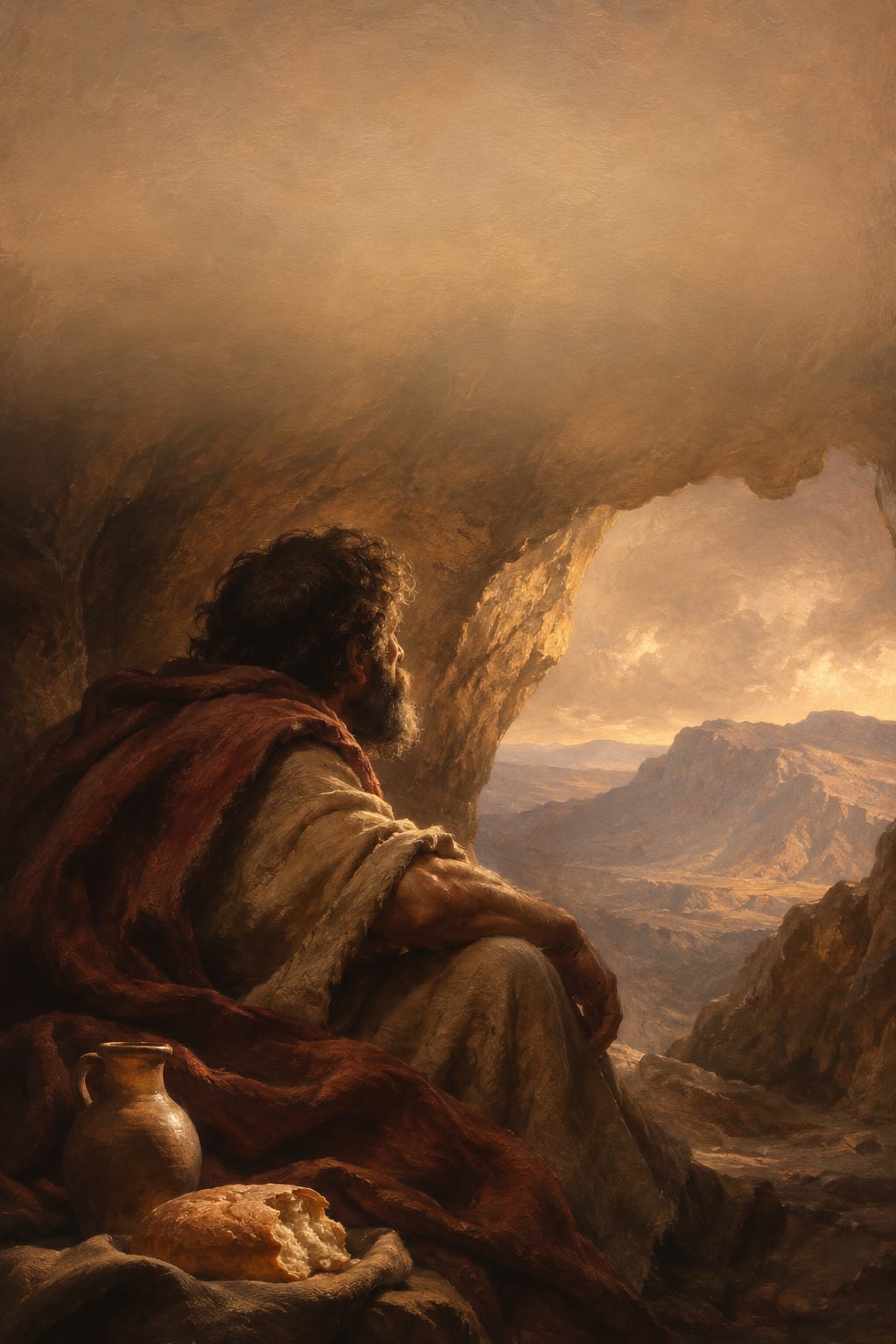
What God does next is one of the gentlest scenes in the prophetic books. He does not call out the cowardice. He does not say, 'After all I just did?' He does not even speak. He sends an angel who touches Elijah and says, 'Arise and eat.' There is bread baked over coals and a jar of water. Elijah eats and lies back down. The angel comes a second time, touches him again, and says the same thing, adding only, 'for the journey is too great for you.'
Then forty days of walking, the long Mosaic number, to Horeb, the mountain of God. The mountain where Moses heard his name. Elijah climbs into a cave and the word of the Lord comes to him with one of the most personal questions in Scripture: 'What are you doing here, Elijah?'
Elijah answers with a complaint that is also a confession. I have been very jealous for the Lord, the God of hosts, for the people of Israel have forsaken your covenant... and I, even I only, am left, and they seek my life, to take it away. He is not exaggerating his terror. He believes he is the last one standing.
God does not argue with the theology. He says, 'Go out and stand on the mount before the Lord.' A great wind tears the mountain. The Lord was not in the wind. An earthquake. The Lord was not in the earthquake. Fire. The Lord was not in the fire. After the fire came qol demamah daqqah: the sound of a thin silence. A low whisper. The Hebrew is almost untranslatable, a voice so quiet it has the shape of stillness.
Elijah wraps his face in his cloak. God asks the same question a second time. What are you doing here, Elijah? Elijah, remarkably, gives the same answer. God does not correct the loneliness. He simply hands Elijah three gifts: a mission (anoint Hazael, anoint Jehu), a companion (anoint Elisha), and a hidden number (seven thousand in Israel whose knees have not bowed to Baal). The cure for the prophet's fear came as a quieter voice and a named family.
By the end of the chapter, Elijah is walking again. He had asked for death, and God gave him a successor.
Today
Carmel does not vaccinate you against the next morning's text message. Most of us know the rhythm. A breakthrough at work, a real moment of obedience, a Sunday when worship landed. Then Monday someone forwards an email or a parent says one disappointed sentence and your nervous system collapses. The voice was twenty-five words long. It cost you a week.
Elijah's God is not embarrassed by that collapse. Look at what he does first: feeds him. Lets him sleep. Lets him sleep again. Does not preach to a hungry prophet. Then walks him to the same mountain Moses got, on a forty-day pilgrimage God knew would be too long for him, and provisions every step.
The question God asks in the cave is the one we usually try to talk our way around. What are you doing here? Not an accusation. An invitation we are afraid to accept: tell me where the fear actually put you. We rehearse the right answer. God listens to the real one twice.
This is what 1 John means by perfect love casting out fear. The fear of one human voice does not yield to courage talks or willpower. It yields to being known. To eating bread you did not earn. To hearing a question that does not punish you for being afraid. To being told, in a voice quieter than the threat that scared you, you are not the only one. Identity given by God is sturdier than identity threatened by anyone else.
At the end of the chapter, the queen is still on her throne. Elijah does not go back to confront her. What heals him is companionship. He goes looking for Elisha, and within a few verses the lonely prophet has a friend. That is the shape of the cure.
Pause
Take a slow breath.
Sit with what you've read.
Ponder
Whose voice has been louder in your head this week than God's whisper, and how long has its echo lasted?
When fear has felt too embarrassing to bring to God, what would it mean to let him feed you before he speaks?
Where might God be naming faithful people you have not seen, to undo your version of 'I, even I only, am left'?
Pray
A prayer
Whispering God, you are the still small voice and the breath behind the fire. Hallowed be your name above every name that frightens us today. May your kingdom come into the places we have run to, and your will be done in cave and broom tree alike. Feed us when we have not earned it. Listen to our same answer twice. Name the people we have not seen, the unbowed thousands you have kept for yourself, and give us a friend to walk with. Forgive us for measuring ourselves by the loudest voice in our day instead of the quietest one in our cave. We confess the prayer, 'I, even I only, am left,' and we surrender it to you. Speak so quietly that the queen cannot hear you, and so clearly that we cannot mistake who we are. Your perfect love casts out our fear.
Amen.
Go in peace.You are not alone.