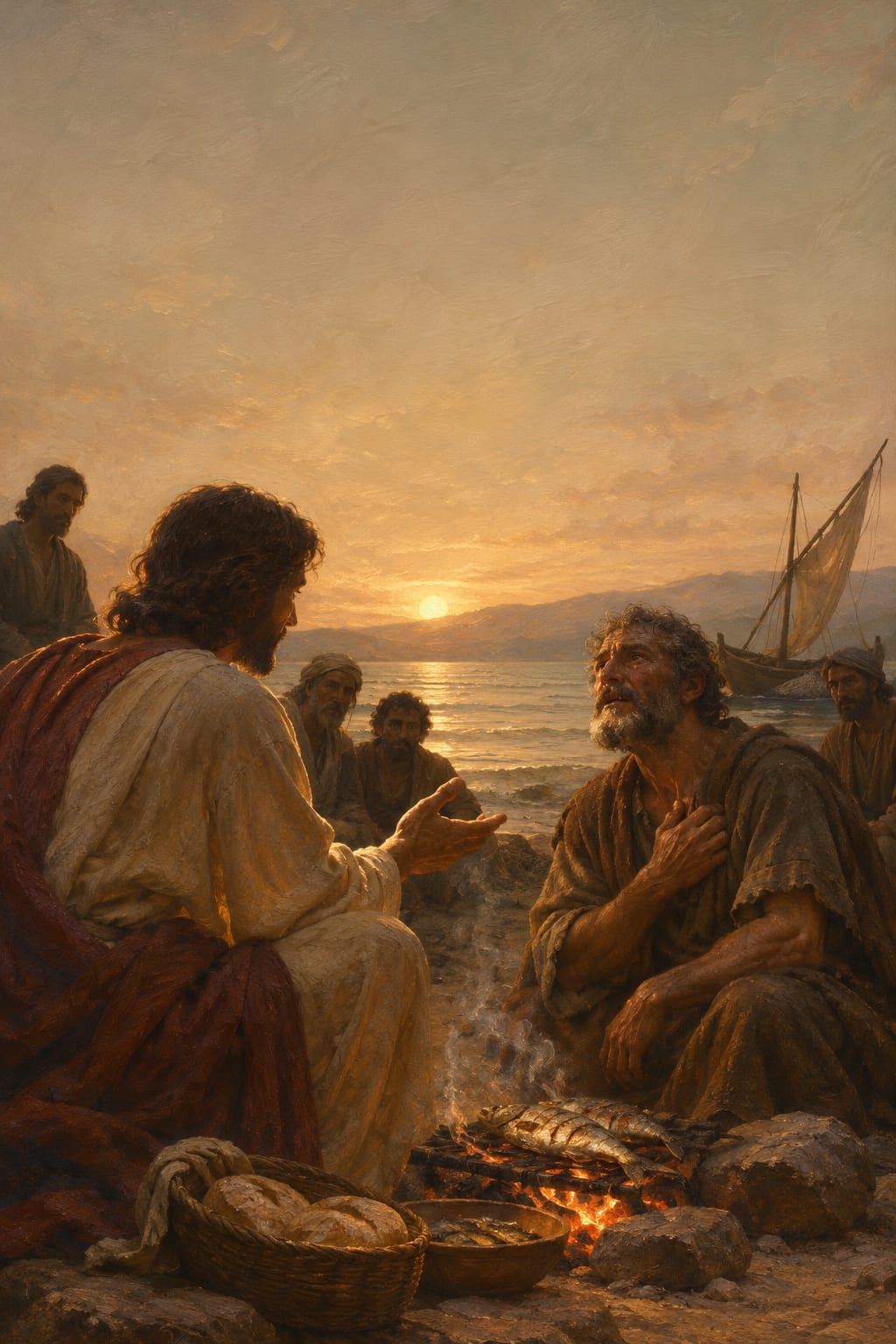
Breakfast With the One You Denied
John 21:1-196 min
Peter denied Jesus three times around a charcoal fire. After the resurrection, Jesus lit another charcoal fire on a beach, cooked breakfast, and asked Peter three times if he loved him. God's response to our failures turns out to be commission, not distance.
Scripture
John 21:1-19
Key moment John 21:15-19
Read
It is the morning after. Peter has gone fishing. I am going fishing, he says, and six other disciples follow him into the boat: Thomas, Nathanael, the sons of Zebedee, two others left unnamed. We will go with you. The text does not moralize about the regression. Peter has not yet been told he is fired. He has not yet been told he is forgiven. The risen Christ has appeared twice in upper rooms, but the conversation has not happened. So Peter goes back to what his hands know.
All night they catch nothing. The Gospel of John echoes the Gospel of Luke now. The same empty net Peter pulled in the morning he was first called. Daybreak comes. A figure is on the shore. Children, have you any fish? They say no. Cast the net on the right side of the boat, and you will find some. They do. The net fills with one hundred fifty-three large fish, more than they can haul.
John, who has noticed things before, notices first. It is the Lord. Peter, who had been stripped for working, puts his outer garment back on and jumps into the water. The reverse of Eden: he has been hiding, now he wants to be seen.
They come ashore and find a fire already burning. The Greek word is anthrakia, a charcoal fire. The word appears only one other time in the New Testament, in John 18:18, when Peter was warming himself at a charcoal fire in the high priest's courtyard, the same night he denied three times that he knew the man. The smell is the smell of his failure. Jesus has lit it on purpose.
Jesus has already cooked some fish and bread. Bring some of the fish you have just caught, he says. There is provision and there is participation. He invites Peter to add to what he has already prepared. Come and have breakfast. Resurrection breakfast. The narrator notices what is in the room. None of the disciples dared ask him, 'Who are you?' because they knew it was the Lord. There is an awkwardness in eating with someone you have wronged, when they are the one cooking. The narrator does not pretend it away.
When they finish, Jesus speaks. He calls Peter by his old name. Simon, son of John. Not 'Peter, the rock.' Back to the name his father gave him, as if to start at the beginning.
Do you love me more than these? Three times he asks. Three denials, three questions. The Greek shifts under the surface. Jesus uses agape the first two times, the deep covenant love. Peter answers with phileo, friendship-love, all he dares claim. The third time, Jesus drops to phileo with him. Even his vocabulary stoops to meet where shame can answer.
Each yes is met not with absolution but with a charge. Feed my lambs. Tend my sheep. Feed my sheep. Peter is trusted with sheep before he is told he is forgiven. The trust is the absolution.
Then Jesus tells Peter the kind of death he will glorify God by. The same man who denied to a servant girl will, the tradition says, hold out his hands on a cross. Love laid the foundation for that endurance.
The last word of the conversation is the first word. The two words Peter heard on this same shore three years earlier, when Jesus first walked up to a fisherman. Follow me.
Today
Carrying a private failure into worship feels like fraud. You do not want to come close because you remember what you did, and you assume God remembers too, but in a colder way than he actually does. So you serve God by doing the small competent things you cannot mess up. You go back to nets. You stay out on the boat. You keep the distance.
What John 21 will not let us forget is that Jesus lit the second fire. Peter did not have to find him. The risen Christ came to where Peter had run, back to Galilee, back to the water, and put the smell of failure into the air on purpose. He did not avoid the wound. He cooked breakfast next to it.
The question is the heart of the chapter. Do you love me? Jesus does not begin with whether Peter is sorry or whether he will ever do it again. He does not even mention the denial. He asks the love question, three times, the same number as the denials, until Peter has spoken aloud three times what was sealed under three nights of weeping. The love is the foundation God starts from, not the apology.
This is how 1 John means perfect love casting out fear. Peter's fear is not the fear of God's anger; he has already seen mercy. It is the fear that the man he denied will be polite forever, that intimacy will be over, that he is competent enough for nets but not anymore for sheep. Jesus answers that fear by handing him sheep before he asks for any apology at all. Trust precedes repair.
The charcoal fire on the shore is for you, too. If you have a failure you keep going back to in your head, look around. There is bread on the coals. There are fish you helped catch in the net. Sit down. Let him ask the question that scares you to hear and answer. Do you love me? When you say yes, he will not stop at 'you are forgiven.' He will say something harder and more healing. Feed my sheep.
Pause
Take a slow breath.
Sit with what you've read.
Ponder
Where in your life are you working the small competent thing because the bigger calling feels disqualified, and what if the question waiting for you is not 'are you sorry?' but 'do you love me?'
Jesus lit a second charcoal fire with the same smell as the first. Where might God be inviting you back to the scene of your failure, not to relive it but to be re-asked?
Peter heard 'Feed my sheep' before he had proved anything. What would change today if you believed God's trust precedes your repair?
Pray
A prayer
Risen Lord, you are the one who lights second fires. Hallowed be your name above the names we have called ourselves since we failed. May your kingdom come into the boats we have gone back to, and your will be done in the breakfasts we did not earn. Give us this morning the courage to come ashore. Ask us your question three times if you must. Hear us answer you know that I love you even when our voice shakes. Stoop your vocabulary down to where shame can speak. Forgive us for the days we have served you from a distance because intimacy felt presumptuous. Forgive us for reading your silence as disappointment. Trust us with sheep before we trust ourselves. Speak the old first words again over us today. Follow me. Your perfect love casts out our fear of our own shortcomings.
Amen.
Go in peace.He has cooked you breakfast.