Fed by Ravens, Sustained by Scraps
1 Kings 17:1-164 min
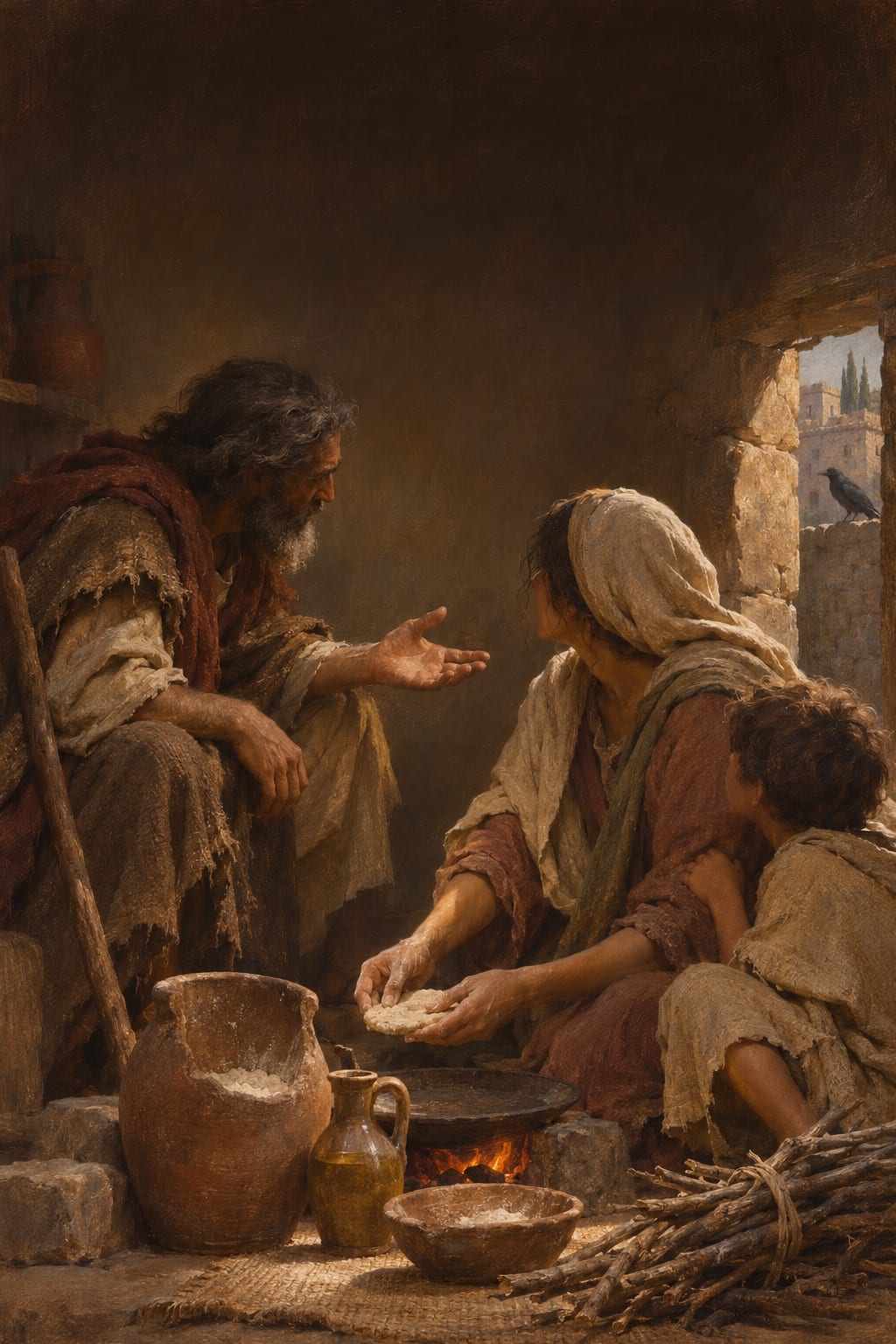
When God sent Elijah to drink from a drying brook and eat bread carried by ravens, then sent him to a widow preparing her last meal, He revealed that divine provision often arrives through the most unlikely and uncomfortable channels.
Scripture
1 Kings 17:1-16
Key moment 1 Kings 17:13-16
Read
Elijah had just delivered the most dangerous sentence in Israel — no rain would fall except at his word. Before the political fallout could reach him, God gave terse instructions: go east, hide by the brook Cherith, and wait. No timeline, no exit strategy. Just a brook and a promise that ravens would bring food.
Ravens. Scavengers. Ritually unclean birds that ate carrion and garbage. God's catering service for His prophet looked nothing like provision was supposed to look. Yet every morning and every evening, bread and meat arrived in beaks that had been God-knows-where. Elijah ate. The water flowed. And then, as drought pressed harder into the land, the brook shrank to a trickle and went dry. God's provision had an expiration date — not because He had forgotten, but because He had somewhere else for Elijah to go.
The next instruction was stranger still: "Go to Zarephath in Sidon and stay there. I have directed a widow there to supply you with food" (1 Kings 17:9). Sidon — Jezebel's homeland, the heart of Baal worship. And this widow was not a woman of means quietly waiting to host a prophet. She was gathering sticks to cook a final handful of flour and a few drops of oil for herself and her son before they starved. She said so plainly: "We will eat it — and die" (v. 12). This was the supplier God had chosen.
Elijah's request sounds audacious: make me something first. But tucked inside that request was a prophetic word — the flour will not run out, the oil will not dry up, until the Lord sends rain. She obeyed. And the jar and the jug held, day after day, in quantities that would never impress anyone. There was no sudden warehouse of grain. Just enough flour clinging to the bottom of the jar each morning. Just enough oil coating the jug. The miracle was quiet, repetitive, and daily — a rhythm of sufficiency that both the prophet and the widow had to re-trust every single morning.
Today
Most of us have a picture of what God's provision should look like — stable, dignified, arriving through channels we'd choose ourselves. A raise, a windfall, a connection that makes sense on paper. Elijah's story dismantles that expectation piece by piece. The brook was temporary. The ravens were unclean. The widow was poorer than he was. Every source God chose would have failed a reasonable person's credibility test.
There may be a brook in your life right now that's drying up — a resource, a role, a relationship that once sustained you but is clearly running out. The temptation is to panic, or to cling harder to the trickle. But a drying brook isn't proof of God's absence. Sometimes it's His relocation notice, a sign that provision is shifting form and address, not disappearing.
And perhaps the next source He's pointing you toward looks impossibly small. A opportunity that seems beneath you. A community you wouldn't have picked. Help arriving from someone who seems to have less than you do. God regularly funnels abundance through scarcity because scarcity keeps the credit where it belongs. The widow's jar never overflowed; it simply never emptied. That's a different kind of miracle than most of us pray for, but it sustained two households through a famine.
The thread running through every scene is obedience before evidence. Elijah went to the brook before the ravens arrived. He asked the widow before the flour multiplied. The provision was real, but it always required a step into what looked foolish first.
Pause
Take a slow breath.
Sit with what you've read.
Ponder
What "brook" in your life might be drying up — and are you clinging to it or listening for where God is directing you next?
Where has God placed provision in front of you that you've dismissed because the source seemed too unlikely, too small, or too uncomfortable?
What would it look like to obey before the evidence arrives — to take the step before you see the supply?
Pray
A prayer
Father, Provider of ravens and widow's jars, I confess that I want provision on my terms — abundant, obvious, and from sources that make sense to me. Forgive me for the times I've looked past what You were offering because it didn't match my expectations. Teach me to recognize Your hand in unlikely places. Give me the courage to obey before I see the supply, and the faith to trust that what looks impossibly small in my hands is more than enough in Yours. Let me not despise the day of small jars. Sustain me, morning by morning, with exactly what I need.
Amen.
The jar will hold. Go and trust the Provider.His supply doesn't need to look impressive. It just needs to not run out.