Jonathan and the Crown He Gave Away
1 Samuel 20:1-426 min
Jonathan loved David enough to risk death warning him, and loved his father enough to stay at his table after the warning. The cost of holding both faithfulnesses is what makes him one of Scripture's most overlooked saints.
Scripture
1 Samuel 20:1-42
Key moment 1 Samuel 20:41-42
Read
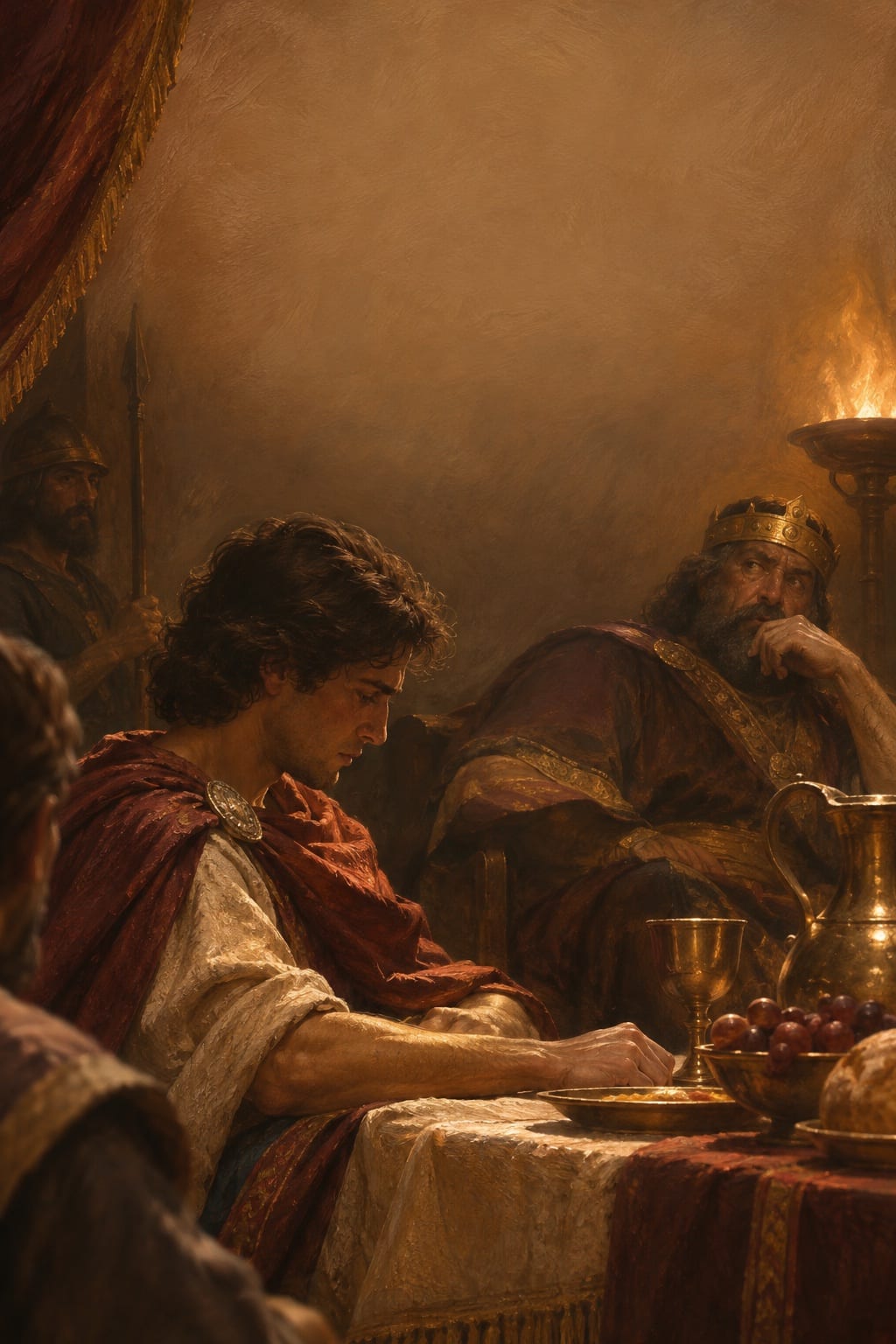
The new moon feast in Saul's palace should have been a holiday. Family gathered, music playing, a place set for the king's son-in-law. David's seat was empty, and Jonathan was the one who had to explain why.
He had a problem no one in the room could see. He loved his father, the unraveling king. He had also bound his soul to his father's rival. Before the second evening was over, only one of those two men would still trust him.
Jonathan was the crown prince of Israel. His armor, his future, and his name were tied to Saul's reign. From the moment he and David met, though, "the soul of Jonathan was knit to the soul of David," and Jonathan stripped off his own robe, sword, and bow and handed them to his friend (1 Samuel 18:1-4). It was prophetic theatre. The clothes of the heir were already changing hands.
David came to him in chapter 20 frightened and clear-eyed. "What have I done? What is my guilt?" Jonathan, still hopeful about his father, could hardly believe Saul meant real harm. They made a plan together: David would skip the new moon feast, and Jonathan would read his father's reaction. They renewed their covenant in the field, weeping.
The Lord be between you and me, and between your offspring and my offspring, forever.
-- 1 Samuel 20:42
The first night of the feast, Saul said nothing. David's empty seat hung over the table like a question. The second night, Saul could not hold it in. He erupted at Jonathan with words no father should aim at a son: "You son of a perverse, rebellious woman... as long as the son of Jesse lives upon the earth, neither you nor your kingdom shall be established." Then he hurled a spear at Jonathan, the same spear he had once thrown at David. In one motion, Jonathan learned that his father would kill the friend he loved, and was willing to wound him to do it.
He left the table grieved, the text says, both for David and at the shame his father had brought on himself.
The next morning he went out to the agreed field with a boy and a bow. He shot an arrow beyond the servant and shouted the prearranged code, "Is not the arrow beyond you?" In one sentence the servant could not decipher, he told David that the road home was closed. The boy gathered the arrows and was sent back to town. Then David rose from behind the stone heap, and the two of them embraced and wept until David wept the more.
They renewed the covenant a final time. Jonathan sent David into the wilderness, then turned and walked back into the house of a king who had just thrown a spear at him.
---
Read carefully, the chapter is two partings. Jonathan parted with David. He also parted, quietly, with the future he had been raised for. The crown was no longer his. It belonged to the man hiding behind the stone. He did not seize it back, and he did not run with David. He stayed under Saul knowing exactly where it ended, knowing he would likely die on the same battlefield where his father fell, which is exactly what happened at Gilboa (1 Samuel 31).
The Hebrew word for the bond between them, ahavah, is the same word used for Israel's love of God in Deuteronomy. It is covenant love, and covenant love does not look for an exit. It accepts the cost.
Today
You may not be in a palace, but you may know exactly where Jonathan was sitting. Someone above you, a parent, a pastor, a boss, a founder, is becoming someone you can no longer fully follow. They are not all wrong. They raised you, taught you, gave you the tools you have. They are also wounding people you love, or wounding themselves, or hurling spears in your direction when you push back. You can see the unraveling, and you can see your own future tied to theirs.
Half of you wants to leave loudly. The other half does not want to dishonor what they have been to you. So you stay, and you cover where you can, and you quietly warn the people they are aiming at, and you wonder if anyone will ever know what this is costing you.
Jonathan tells the truth that this kind of staying is not weakness. He is not naive. He sees Saul clearly. He has calculated his own future and concluded that he will remain under his father's collapsing kingdom rather than seize his way out of it. His name lives in Scripture as one of the most loved figures in the whole story, because David, who loved few people, loved him.
There is a second consolation in the chapter, almost too quiet to notice. The throne Jonathan should have inherited went to the friend he protected. He had given his robe away years before he gave his life away. The dream did not die when David took it; it had already been laid down, freely, on the floor of Jonathan's heart. That is the freedom Scripture is offering here. You can yield what you thought was yours to someone you trust God is calling instead, and find that yielding is a more honest crown than ruling would have been.
You do not have to choose between loving an authority and loving the people that authority cannot see straight on. You can hold both. It will cost you. It will also keep you upright in a season designed to bend you.
Pause
Take a slow breath.
Sit with what you've read.
Ponder
Where in your life are you currently caught between honoring an authority and protecting someone that authority cannot see straight on?
What would it look like for you to stay under your authority without endorsing what they are doing?
Is there something you have considered yours, a position or dream or ambition, that you sense God asking you to lay down for someone else the way Jonathan laid down his own?
Pray
A prayer
Faithful Father, the One whose love knit Jonathan's soul to David's, hallowed is your name in every house that has begun to fracture. Let your kingdom come in mine, and let your will be done over my own. Give me today the bread of two faithfulnesses: the courage to warn, and the steadiness to stay. Forgive me where I have used the failures of my authorities as permission to stop honoring them, and where I have used my honor as a place to hide from the truth. Lead me away from the easy exits. Deliver me from the bitterness that grows in fields where spears have been thrown. And give me the dignity to let the crown pass to whoever you have chosen, even when you have not chosen me.
Amen.
Go gently into your two faithfulnesses.You are seen in the field.