The Basket Was the Beginning
Exodus 1:22-2:107 min
A young mother under a death decree hides her infant for three months, then sets him on the river in a basket she wove with her own hands. Her quiet mothering becomes the soil where a nation's deliverer takes root.
Scripture
Exodus 1:22-2:10
Key moment Exodus 2:7-9
Read
She is not named in the first telling. The text just says, a man of the house of Levi went and took as his wife a Levite woman. No fanfare. No prophecy whispered over her head. Only later, in Exodus 6:20, do we learn her name: Jochebed, which means the LORD is glory. The woman whose hands shaped a deliverer was a footnote before she was a hero.
She was pregnant when the decree came down. Pharaoh had grown afraid of the Hebrews multiplying in his land, so he ordered every Hebrew baby boy thrown into the Nile. Imagine carrying a child to term inside that sentence. Imagine the labor pains arriving on top of that dread.
Then the baby comes. And when she saw that he was a fine child, she hid him three months. Three months of nursing in whispers. Three months of muffling cries against her chest. Three months of bargaining with God in the dark while her arms ached from holding still.
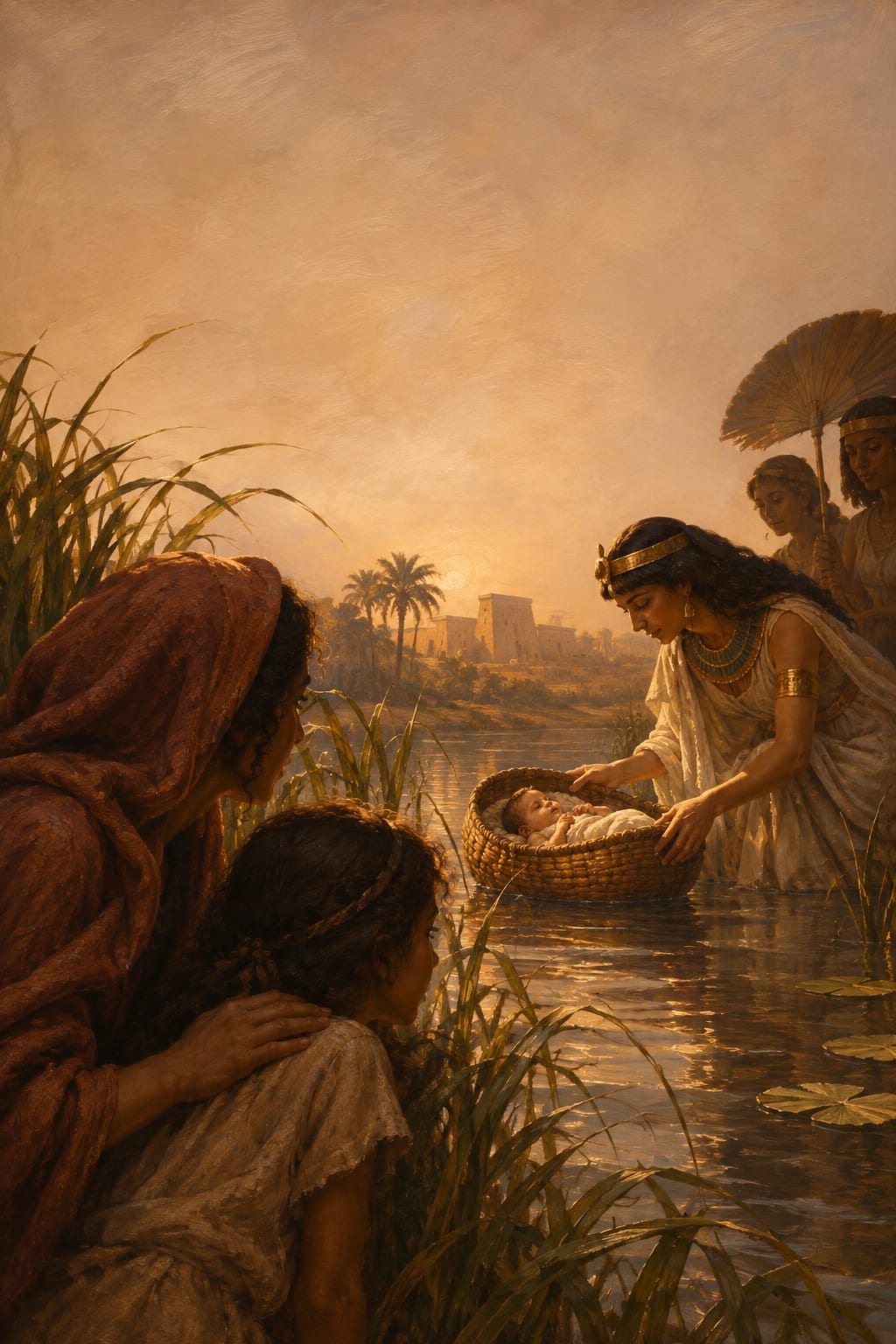
Then the hiding stops working. He's too big, too loud. So she does something the text describes with surprising tenderness: she takes a papyrus basket, daubs it with bitumen and pitch, places her son inside, and sets it among the reeds at the river's edge.
Notice the Hebrew here. The word for the basket Jochebed weaves is tevah — the same word used for Noah's ark. It appears only twice in the entire Hebrew Bible. Once for the vessel that carried humanity through the flood. Once for the basket that carried Moses through the river. Jochebed is building an ark. With her hands. For her son.
She doesn't pray and wait. She works. She weaves. She waterproofs. She makes a thing that floats. Then she releases what she has formed into a current she cannot control, and she stations her daughter Miriam in the reeds to watch.
What happens next is one of the most quietly subversive scenes in Scripture. Pharaoh's daughter comes to bathe. She finds the basket. She has compassion. Miriam, sharp and brave, steps forward: Shall I go and call you a nurse from the Hebrew women to nurse the child for you? And Pharaoh's daughter says yes.
So Miriam runs and gets her own mother.
And then comes the line that should make every mother weep: Take this child away and nurse him for me, and I will give you your wages. Pharaoh's wages. Paid to a Hebrew slave woman. To raise her own son. Inside the regime that wanted him dead.
For years — the text doesn't say how many, but ancient weaning could stretch to age three or four — Jochebed had her boy back. She nursed him. She sang to him. She told him who he was. She named God to him in a language Pharaoh's court would later try to make him forget. By the time she handed him over to the palace, the foundation was already poured.
Moses would grow up Egyptian on the outside and Hebrew underneath. The deliverer who would one day stand before Pharaoh and say let my people go learned the name of the LORD on his mother's lap. The man who would split the sea was first carried through water in a basket his mother wove.
The text never calls Jochebed a prophet. It never says God spoke to her in a dream. She is not given a song like Hannah or a vision like Mary. She is given a baby, a death sentence, a river, and her own two hands. With those, she shapes history.
Today
You are afraid of disappearing.
You had a vision once. Maybe you still do. There were things you wanted to build, places you wanted your name attached, work that felt like yours. Now there is a small person who needs you with a need that has no off switch, and the woman you used to be feels like she is fading into a role. Just mom. You said it once and felt the word just land like a stone.
Hear this carefully. Jochebed was not pausing her calling when she nursed Moses. She was executing it. The hands that wove the basket were the same hands that shaped the deliverer. The whispered Hebrew lullabies in a Levite hut were the soil where a liberator's identity took root. There was no real work happening elsewhere that she was missing. The work was the child. The work was the formation. The work was making a soul that could one day stand in a throne room and not flinch.
The culture around you will measure your output the way Egypt measured bricks. Visible, countable, scalable. Mothering looks like very little to that economy. Hours that don't show up on a resume. Conversations no one records. A thousand small acts of presence that vanish into the rhythm of a day. But Scripture keeps quietly insisting that the most history-bending work often happens in rooms no one is watching.
This does not mean your other gifts disappear. Jochebed was a weaver, a strategist, a woman with the kind of nerve that puts her child in a river under a king's nose. She didn't stop being any of that when she became a mother. Those very capacities became the way she mothered. The vision you have, the mind you have, the voice you have — these are not on hold. They are how you will form this person. And in seasons to come, they will surface in other rooms too.
But today, three weeks postpartum, with milk-stained shirts and a body still learning itself again, hear what the text is whispering: the basket you are weaving right now matters. The nights you cannot remember tomorrow are building something. You are not a footnote to your own life. You are doing the dream-work. The deliverer in your arms does not yet know what he or she will become, and neither do you. But the formation is happening, and you are the one God chose to do it.
You are not just anything. You are forming a soul. That is the work.
Pause
Take a slow breath.
Sit with what you've read.
Ponder
Where did the word just attach itself to your sense of mothering, and whose voice was it really?
If the hidden work of forming this child is itself a vocation God has called you to, what would change about how you carry today?
What gifts and visions did you bring into motherhood that are not gone, only changed in shape — and how might they show up in the way you mother?
Pray
A prayer
God of Jochebed, God of glory in hidden places, You see the women history forgot to name. You weave deliverance through the hands of mothers no one writes songs about. Be honored in this small room. Be honored in the rocking chair, the night feeds, the body still healing. Your kingdom come in this child. Your will be done in the soul I am forming. Let what I whisper now become what shapes a life that one day stands and speaks for the people you love. Father, I confess the fear that I am disappearing. I bring you the parts of me that ache to be seen, to build, to be called by my own name again. Hold those parts. Do not let them die. Show me they are not gone, only present in a different shape — in the patience I am learning, the love I am pouring, the strength my hands are finding. Teach me to call this work what it is. Not a detour. Not a pause. A vocation. Give me eyes to see the basket I am weaving. Give me courage to release what I have formed into currents I cannot control, trusting the daughter you have stationed in the reeds to watch. And when the season turns and other rooms open again, let me walk into them carrying everything this one taught me. Let nothing be wasted. Let no part of me be lost. In the name of the One who was first carried in a mother's arms before he carried the world,
Amen.
Go gently.The basket you are weaving matters.