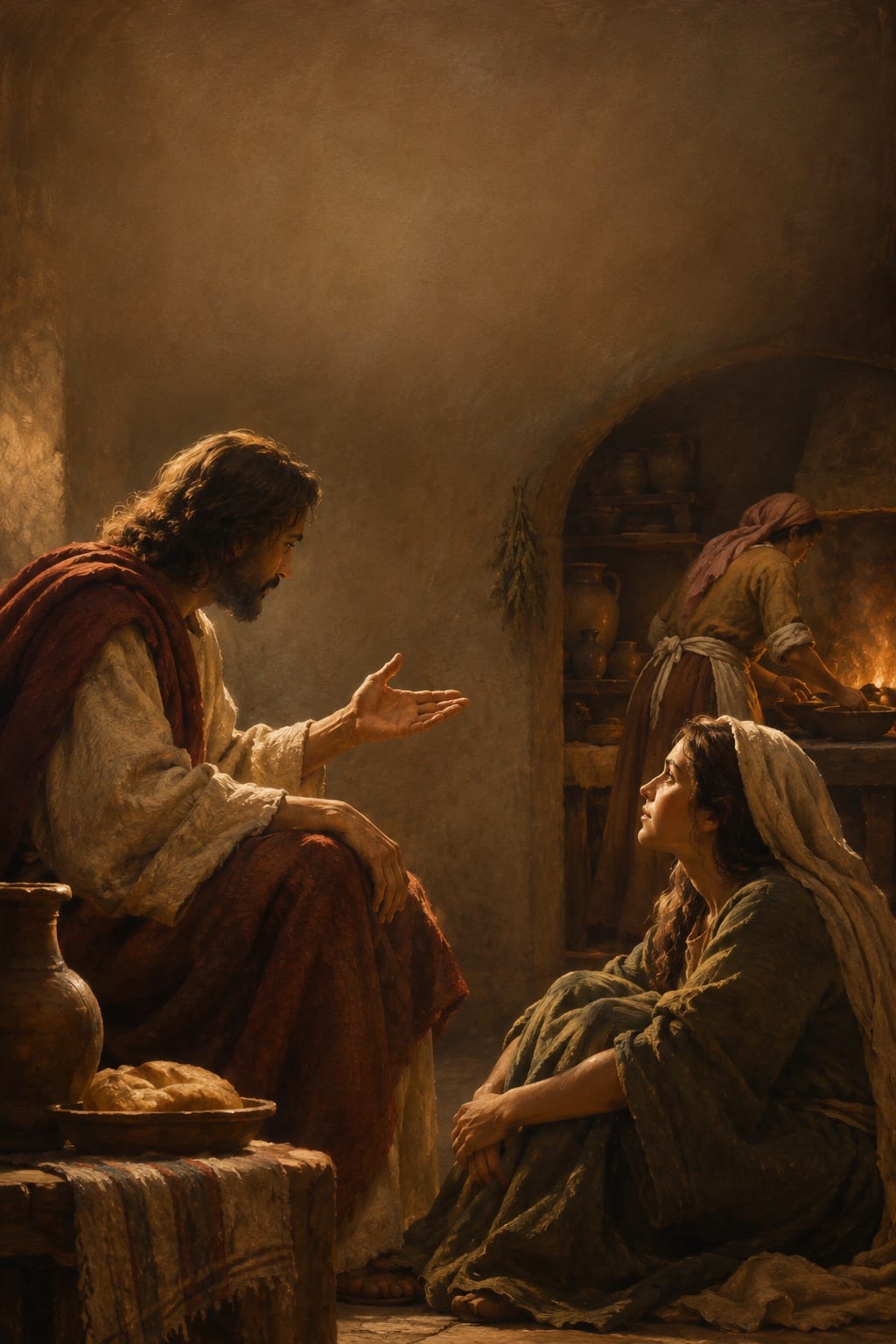
The Better Thing Mary Chose While the Kitchen Burned
Luke 10:38-426 min
Mary sits on the floor at Jesus' feet while her sister works herself raw in the kitchen, and Jesus defends her for it — calling presence the one thing that will not be taken away.
Scripture
Luke 10:38-42
Key moment Luke 10:41-42
Read
There is a meal in the air and a guest in the house, and the temperature in Martha's kitchen is rising.
Luke gives us this scene with almost no setup. Jesus enters a village, and a woman named Martha welcomed him into her house. Notice the verb. She welcomed him. The home is hers. The hospitality is her instinct, her offering, her love-language pressed into bread and pots and table linen. This is not a small thing. To open your home to an itinerant rabbi and his entourage is to commit yourself to hours of labor.
Then comes the line that splits the room.
She had a sister called Mary, who sat at the Lord's feet and listened to his teaching.
-- Luke 10:39
Sat at his feet. In first-century Jewish culture, this is the posture of a disciple. Paul will later use the exact phrase to describe his own training: brought up in this city at the feet of Gamaliel. Sitting at a rabbi's feet is the seminary seat. It is also, in that culture, almost exclusively a man's seat. Mary takes it without asking permission. She slides past every assumption about what a woman in her own house should be doing when company arrives, and she takes the disciple's place on the floor.
Martha is in the kitchen, distracted with much serving. Luke uses periespato — pulled in many directions, dragged around by the tasks. The Greek almost has a sound to it: a woman being yanked from one chore to the next while the conversation she most wants to be in happens twenty feet away without her.
Finally she breaks. She does not go to Mary. She goes to Jesus.
Lord, do you not care that my sister has left me to serve alone? Tell her then to help me.
-- Luke 10:40
Hear the layers in that. Do you not care. The accusation underneath every overworked servant's prayer. The suspicion that love must look like exhaustion or it doesn't count. The conviction that the right people, including God, should be on her side of the kitchen door.
Jesus answers her with her name twice, the way a parent does when a child is overwhelmed.
Martha, Martha, you are anxious and troubled about many things, but one thing is necessary. Mary has chosen the good portion, which will not be taken away from her.
-- Luke 10:41-42
He does not shame the serving. He does not tell her dinner does not matter. He renames what is happening. Anxious and troubled — merimnas kai thorybazē — worried inside, and stirred up outside. Both at once. He sees the cost of her labor, and he refuses to monetize her exhaustion as proof of love.
And then the line that has comforted and stung the church for two thousand years: Mary has chosen the good portion. Literally, the good part. The same word used in the Septuagint for the Levite's inheritance — the Lord is my portion. Mary, by sitting still, has chosen God himself as her share.
The meal got served. We know it did, because Luke tells us nothing more about it. The detail that survived was not the menu. It was the woman on the floor, and the rabbi who refused to send her back to the kitchen.
Today
You may be the one with flour on your hands and resentment in your throat.
You know how to love by doing. You serve, you organize, you anticipate, you carry. The list is the language. You can feel the satisfaction of a task closed and the moral weight it carries: I am someone who shows up. And underneath the competence is a quieter belief you may not have named yet — that proximity to Jesus must be earned by productivity for him. That sitting still while there is bread to bake is a kind of theft.
Mary refuses that math. She is not lazy. She is not avoiding work. She is making a calculation Martha has not made: that the rabbi sitting in her living room will not always be sitting in her living room, and bread will be there tomorrow, and the disciple's seat is open right now. She chooses proximity over usefulness, and Jesus calls it the better thing.
This is hard for those of us who have built whole identities on being the one who gets it done. To stop, to sit, to listen, feels like dereliction. It feels like letting someone else carry the weight. The voice in your head sounds exactly like Martha's: Lord, do you not care. You cannot quite believe Jesus would defend the still one over the busy one.
He does. He still does. He looks at the meal you are trying to cook for him and says your name twice, and he tells you that one thing is necessary. Not many things. One. The good portion is not extracted from you. It is given to you, on the floor, in silence, while the kitchen waits. Choose it today, even if dinner is late. Especially if dinner is late.
Pause
Take a slow breath.
Sit with what you've read.
Ponder
What task have you been treating as proof of your love for Jesus, and what would it mean to let it go undone in order to sit at his feet?
When was the last time you felt accused, like Martha, that no one cares how hard you are working — and what is that accusation actually asking for?
If presence is the good portion that cannot be taken away, what is the smallest way you could choose it today before you choose the next task?
Pray
A prayer
Lord Jesus, the One who sat in Martha's house and called Mary's stillness good, you are the rabbi who teaches on the floor, the guest who refuses to be paid for his presence in productivity. Let your kingdom come in the rooms of my life where I have built a kitchen as a hiding place, and let your will be done in the slowing of my hands. Forgive me for treating service as the only credible language of love, and for the times I have asked you, like Martha, why you do not seem to care that I am carrying so much alone. Give me today the courage of the woman who sat down. Give me ears that listen before they plan, a body that rests before it serves, a soul that lets you be the host even in my own house. And when I am pulled in many directions, say my name twice, and remind me that the good portion is already mine, and it cannot be taken away.
Amen.
Sit down for a while.The good portion cannot be taken from you.