The Double Portion Elisha Refused to Apologize For
2 Kings 2:1-155 min
On the day his master is taken, Elisha asks for twice the spirit that formed him — and the chariots of fire confirm this was never a self-made succession.
Scripture
2 Kings 2:1-15
Key moment 2 Kings 2:9-12
Read
They walk together for the last time and Elisha will not let go.
From Gilgal to Bethel, Bethel to Jericho, Jericho to the Jordan, Elijah keeps testing the doorway: Stay here, the Lord has sent me on. Three times he offers Elisha the easier exit. Three times Elisha answers with the same stubborn vow: As the Lord lives, and as you live, I will not leave you.
He knows what is coming. The company of the prophets at every stop has whispered it to him with that strange tenderness people reserve for the almost-bereaved: Do you know that today the Lord will take your master from you? Elisha cuts them off. Yes, I know. Be silent. He does not need their grief management. He needs to stay close.
At the Jordan, Elijah rolls up the mantle, strikes the water, and the river splits. Fifty prophets watch from a distance. Two men cross dry ground into the place where the world thins.
Then Elijah turns and asks the question that has been waiting at the end of every road: Ask what I shall do for you, before I am taken from you.
Elisha does not flinch.
Please let there be a double portion of your spirit on me.
-- 2 Kings 2:9
Hear what he is asking. In Deuteronomy 21:17, the pi shenayim — the double portion — is the firstborn's inheritance. Two shares of the estate while every other son receives one. Elisha is not biologically Elijah's son. He left his oxen and his parents to pour water on this man's hands. And now, on the threshold of separation, he claims the firstborn's share.
This is not modesty. It is not a polite request for some of what Elijah carried. It is the bold, scandalous claim of a son who has decided that proximity has made him heir.
Elijah does not rebuke him. He calls it a hard thing — a difficult thing you have asked — and ties the answer to a sign Elisha cannot manufacture: If you see me when I am taken from you, it shall be so for you; but if you do not see me, it shall not be so.
The seeing is the test. Stay near enough, watchful enough, awake enough, to witness the going.
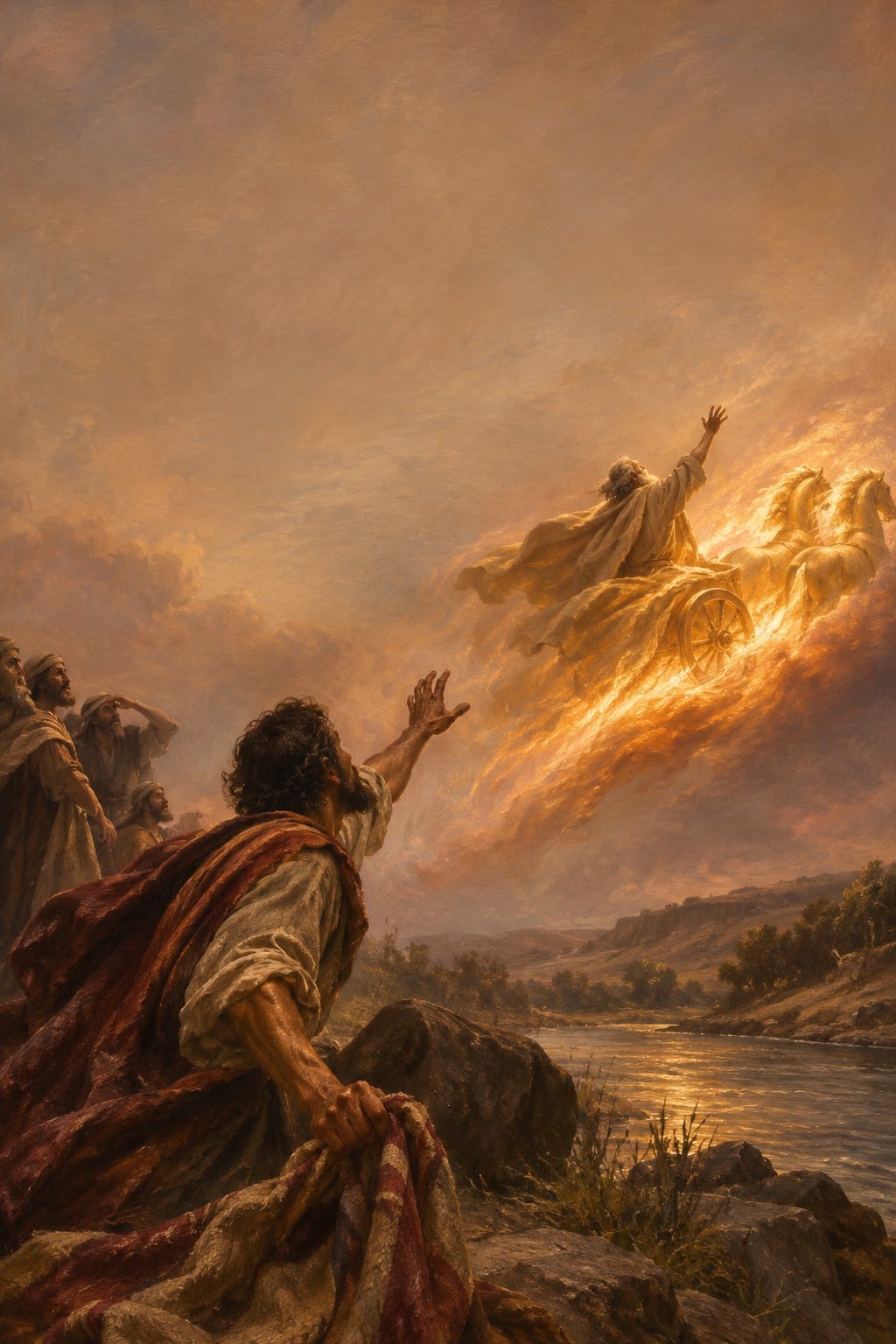
And then the sky tears open.
Behold, chariots of fire and horses of fire separated the two of them. And Elijah went up by a whirlwind into heaven.
-- 2 Kings 2:11
Elisha sees. He cries out, My father, my father! The chariots of Israel and its horsemen! — the very title he himself will be given on his deathbed decades later. He tears his own clothes in two. Then he picks up the mantle that fell from Elijah, walks back to the Jordan alone, and strikes the water with the question of every successor: Where is the Lord, the God of Elijah?
The river splits again.
The fifty prophets watching from Jericho see it and bow. The spirit of Elijah rests on Elisha. And the record will show, in the chapters that follow, miracle after miracle — by traditional count, twice as many as Elijah performed. The boy who poured water now raises the dead, multiplies oil, heals leprosy, feeds a hundred from twenty loaves, makes iron float.
The double portion was real. The chariots were real. He never confused the two.
Today
You may be living the strange grace of being formed by someone whose ceiling is becoming your floor.
The person who taught you to pray, to lead, to think, to build — you can feel it now: God is asking you to carry more than they carried. Not because they failed. Because the assignment moved. The territory you are being sent into has rooms they were never asked to enter.
And something in you is afraid to want it. You wonder if asking for the double portion is arrogance dressed up as calling. You wonder if surpassing them dishonors them. You hedge your prayers. You ask God for a fraction of what is actually being placed in your hands, because a fraction feels safer to confess.
Elisha refuses that hedge. He stays close all the way to the Jordan. He claims the firstborn's inheritance from a master he was not born to. And when the chariots come, he tears his own clothes — because he knows, in his body, that no amount of mantle-grabbing makes this a self-made succession. The fire in the sky is not optional. It is the thing that turns inheritance into anointing.
So ask. Boldly. Let there be a double portion of your spirit on me. And then keep your eyes open the whole way to the Jordan, because God will not let you forget who tore the sky for you. The mantle in your hand and the chariots in the air belong together. One without the other is either pretension or paralysis. Together they are a son walking back across the river that just opened a second time, carrying what his father carried and more, because the Lord, the God of Elijah, is also the Lord, the God of him.
Pause
Take a slow breath.
Sit with what you've read.
Ponder
Where in your life is God asking you to carry more than the person who formed you, and what is making you hedge the request?
What would change if you stopped treating bold asking as the opposite of humility and started treating it as the fruit of staying close?
When the mantle falls, what will help you remember that the chariots came first?
Pray
A prayer
Lord, God of Elijah and God of Elisha, you are the Father who hands down inheritance, the One who tears the sky and never lets succession become self-made. Let your kingdom come in the territory you are sending me into, and let your will be done through a portion of spirit larger than I would dare ask for on my own. Give me today the courage of the apprentice at the Jordan — to stay close all the way to the threshold, to see what you are doing, to pick up what falls without pretending I made it fall. Forgive me for the small asking I have used as a costume for humility. Forgive me for the moments I have grabbed at mantles without lifting my eyes for the fire. Place your double portion on me for the sake of the people you are sending me to, and keep me forever the son who cried my father, my father before he ever struck the water.
Amen.
Go and ask boldly.The chariots came first.