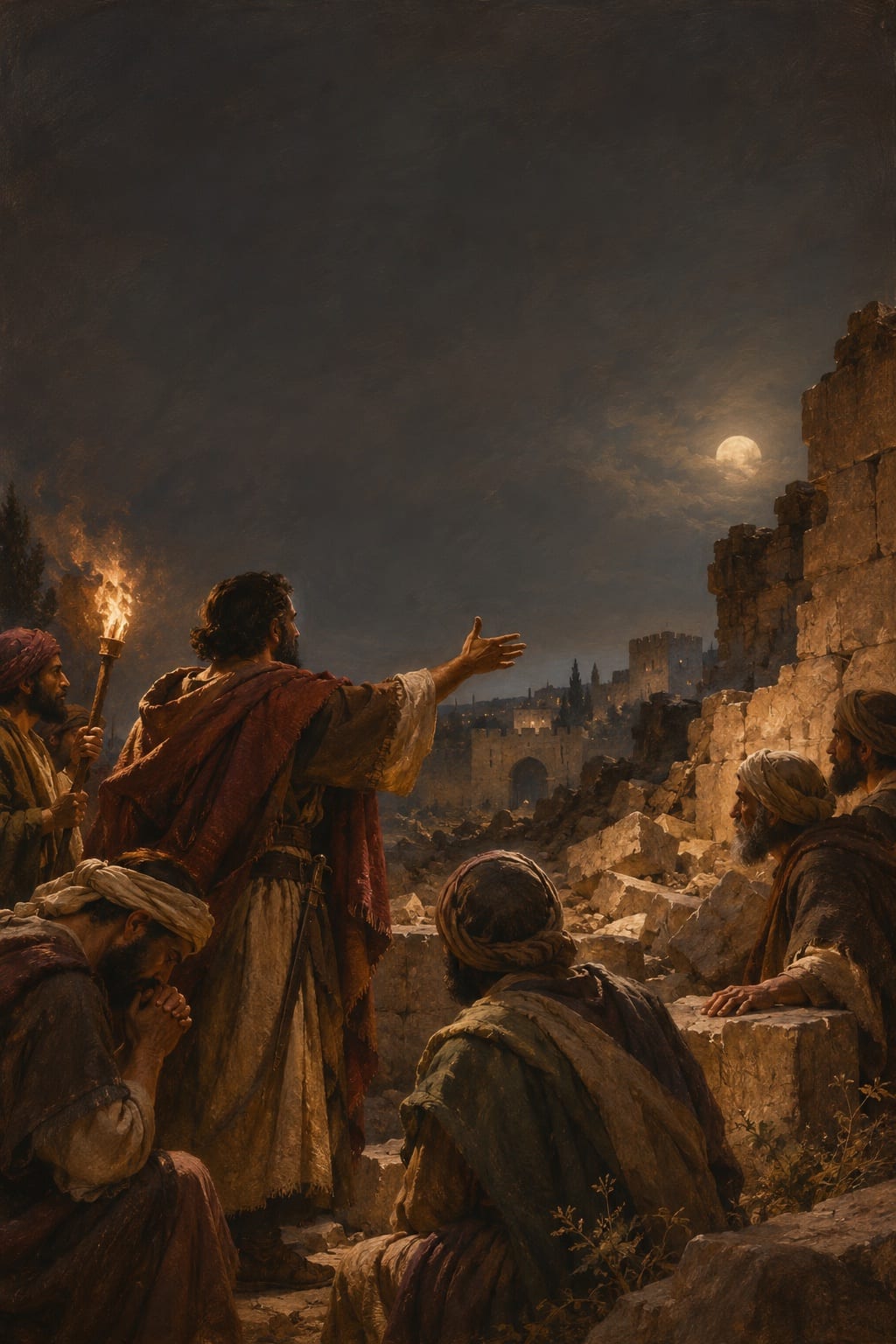
The Midnight Ride Around the Rubble
Nehemiah 2:11-203 min
Nehemiah's secret nighttime inspection of Jerusalem's shattered walls reveals a pattern for anyone facing ruin: look honestly at what's broken, grieve it, pray through it, and then invite others into the work of rebuilding.
Scripture
Nehemiah 2:11-20
Key moment Nehemiah 2:17-18
Read
Jerusalem's walls had been rubble for over a century. People had walked past the wreckage so many times it had become scenery. Then a cupbearer from Persia arrived and, after three quiet days in the city, slipped out on a donkey in the dark. Nehemiah didn't announce himself. He didn't form a committee or issue a proclamation. He rode through the Dung Gate and along the charred stones with a few trusted men, and he simply looked.
That looking was itself an act of faith. The Hebrew word translated "inspected" carries the sense of probing carefully, the way a physician examines a wound. Nehemiah didn't glance and move on. He lingered in the debris fields where the rubble was so thick his donkey couldn't pass. He measured the damage without minimizing it. Before he could speak a single word of vision, he needed the full, unvarnished truth of what had been lost.
Only after that honest survey did he speak. "You see the trouble we are in," he told the people — we, not you. He named the disgrace plainly, then immediately offered evidence that God's hand had already been at work: the king's favor, the letters of safe passage, the timber already granted. The response was immediate: "Let us start rebuilding" (2:18). Sanballat and Tobiah mocked the effort before the first stone was lifted, but Nehemiah's reply was spare and steady: "The God of heaven will give us success" (2:20).
The walls would go up in fifty-two days, a feat that stunned even Israel's enemies. But the foundation of that speed was laid in the slow, silent ride through the dark — one man willing to see the worst and still believe the best was possible.
Today
Most of us have rubble we've stopped seeing. A marriage that lost its warmth years ago, a calling we quietly abandoned, a community we drifted from. The wreckage becomes background noise; we route our daily paths around it without conscious thought. Nehemiah's example suggests that avoidance is not the same as peace, and that God sometimes calls us back to the Dung Gate — to the least glamorous corner of the mess — before any rebuilding can begin.
Honest assessment takes courage because it means admitting that something we cared about is genuinely broken. It also takes faith, because you don't inspect ruins unless you believe reconstruction is worth attempting. Nehemiah wept, fasted, and prayed for months before he ever mounted that donkey. The survey wasn't despair dressed up as realism; it was informed hope, the kind that refuses to build on wishful thinking and insists on building on truth.
Notice, too, that Nehemiah didn't rebuild alone. He turned his private grief into a communal invitation: come, let us rebuild. Some of the walls in your life won't go up without other hands. Asking for help is not weakness; it is wisdom patterned after a man God called "my servant." And when the mockers come — they always come — the response is not a detailed defense plan. It is a quiet declaration: the God of heaven will give us success.
Pause
Take a slow breath.
Sit with what you've read.
Ponder
What broken place in your life have you been walking past so long it feels like scenery?
If you took a quiet, honest ride around the rubble tonight, what would you find — and who might you invite to rebuild with you?
Where has God already been working behind the scenes, granting favor you haven't fully recognized?
Pray
A prayer
Father of restoration, You who rebuild ruined cities and raise up ancient foundations — I confess that I have avoided looking honestly at what is broken. I have walked past rubble and called it normal. Give me the courage Nehemiah carried on that midnight ride: eyes open, heart steady, faith intact. Show me where Your hand has already been moving, and bring me the people I cannot rebuild without. Let Your will be done in the broken places, even when the work feels slow and the mockers are loud. Protect this rebuilding from discouragement and from my own impatience. I trust that the God of heaven will give success.
Amen.
Go survey the walls. God rides with you.What is broken is not beyond His hand.