The Name He Could Not Find
Genesis 2:18-255 min
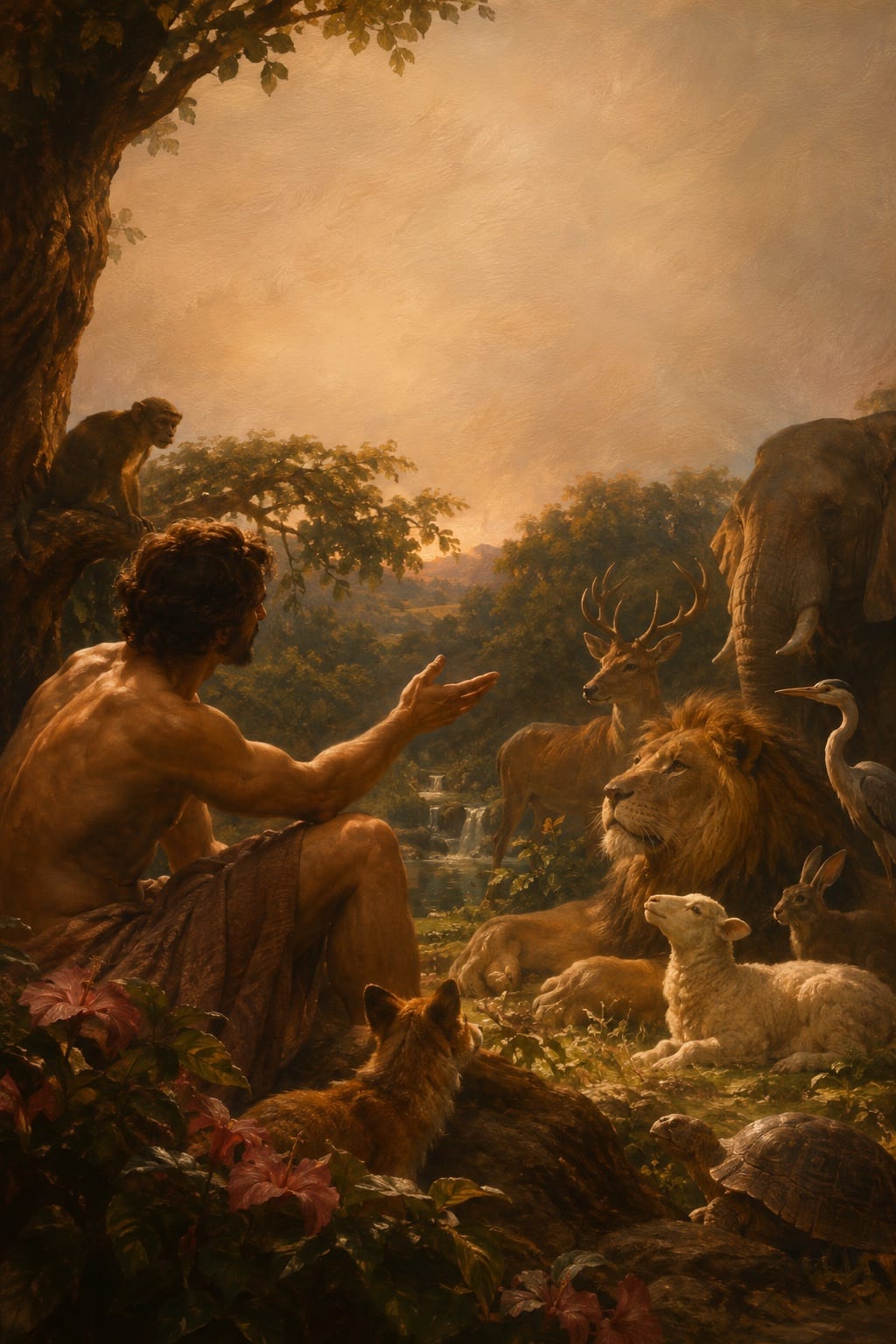
Before Eve, Adam walks through a garden of creatures and names them one by one, and in that naming he discovers the shape of his own aloneness. Self-knowledge arrives through encounter with what he is not.
Scripture
Genesis 2:18-25
Key moment Genesis 2:19-20
Read
The garden is full. Rivers run through it, fruit hangs from the branches, light pours through leaves. And in the middle of all this abundance, God says something startling.
It is not good that the man should be alone.
-- Genesis 2:18
This is the first not good in Scripture. Everything else, so far, has been called good. Light, land, sea, creatures. But here, inside a paradise, God names a lack.
What follows is strange and beautiful. Instead of immediately creating the companion Adam needs, God brings animals. One by one. A parade of otherness.
Out of the ground the Lord God formed every beast of the field and every bird of the heavens and brought them to the man to see what he would call them.
-- Genesis 2:19
Adam names them. In Hebrew thought, to name something is to know it, to perceive its essence. The word here, qara, carries the weight of recognition, of calling a thing what it truly is. Adam looks at a lion and sees lion. He looks at a sparrow and sees sparrow. Each creature is met, considered, and named.
But notice what else is happening. With every name, Adam is also learning something about himself. He sees the ox and knows, I am not that. He watches the eagle lift into the sky and feels, I am not that either. Each encounter is a small act of self-discovery. Every creature he is not becomes a quiet mirror showing him who he is.
And then the text says something tender.
But for Adam there was not found a helper fit for him.
-- Genesis 2:20
The Hebrew phrase is ezer kenegdo, often translated a helper suitable for him, though the words carry more weight than that. Ezer means a strong helper, a word used elsewhere of God himself. Kenegdo means corresponding to, facing, alongside. A counterpart. Someone who stands across from him and reflects him back.
Adam could not have known what was missing until he had catalogued everything that did not fit. His longing had to be named before it could be answered.
Then God acts. A deep sleep falls on Adam. From his own side, God forms the one who will stand facing him. And when Adam wakes, his first recorded words are not a name given to a creature below him, but a recognition of a self alongside him.
This at last is bone of my bones and flesh of my flesh.
-- Genesis 2:23
This at last. The phrase trembles with relief. He knows her because he has spent a garden's worth of days learning what he is not.
Today
You have probably felt this without having words for it. The sense that you only began to understand yourself once you bumped into someone who was nothing like you. A friend whose calm exposed your restlessness. A sibling whose certainty made you aware of your doubt. A stranger whose grief made you realize how much you had been numbing your own.
We often think self-knowledge comes from looking inward. Sitting quietly. Journaling. Asking ourselves who we are. These things matter. But Genesis suggests something else is also true: we come to know ourselves by standing near what we are not.
The creatures Adam named were not obstacles to his identity. They were the teachers of it. Each one clarified the outline of him by being different from him. His introversion would not have a name without their clamor. His hunger for conversation would not have a shape without their silence.
If you feel unsure of who you are right now, consider that God may be doing with you what he did with Adam. Bringing encounters, friendships, disappointments, and differences across your path, not to confuse you but to help you see the edges of your own soul. The coworker who frustrates you is showing you what you value. The culture that feels foreign is revealing what feels like home. The version of yourself you used to be, and no longer are, is teaching you who you have become.
And beneath all of it, there is this: the God who noticed Adam's aloneness before Adam did is the same God who sees you. He does not rush the process. He walks the creatures past, one at a time, until you are ready to recognize the gift when it stands in front of you.
You are being formed through every encounter. Even the ones that do not fit.
Pause
Take a slow breath.
Sit with what you've read.
Ponder
Who or what in your life has shown you something about yourself that you could not have seen alone?
Where are you currently experiencing a not good aloneness, and what might God be naming in that lack?
What differences in others have you been resisting that might actually be clarifying who you are?
Pray
A prayer
Father who knows me before I know myself, Hallowed is your name in the quiet work of my becoming. You saw Adam's aloneness before he did, and you see mine now. Let your kingdom come in the places where I am still searching for my own shape, and your will be done in the encounters you have already set in my path. Give me today the bread of self-knowledge, not all at once, but one creature at a time. Forgive me for the moments I have resented the people who were nothing like me, when you were using them to show me myself. Help me forgive those whose difference has wounded rather than clarified. Lead me not into the loneliness of believing I must figure myself out alone, but deliver me into the ezer kenegdo relationships that stand across from me and reflect me back. Teach me to recognize, when the gift arrives, what Adam knew: this at last.
Amen.
Go gently.You are being known.