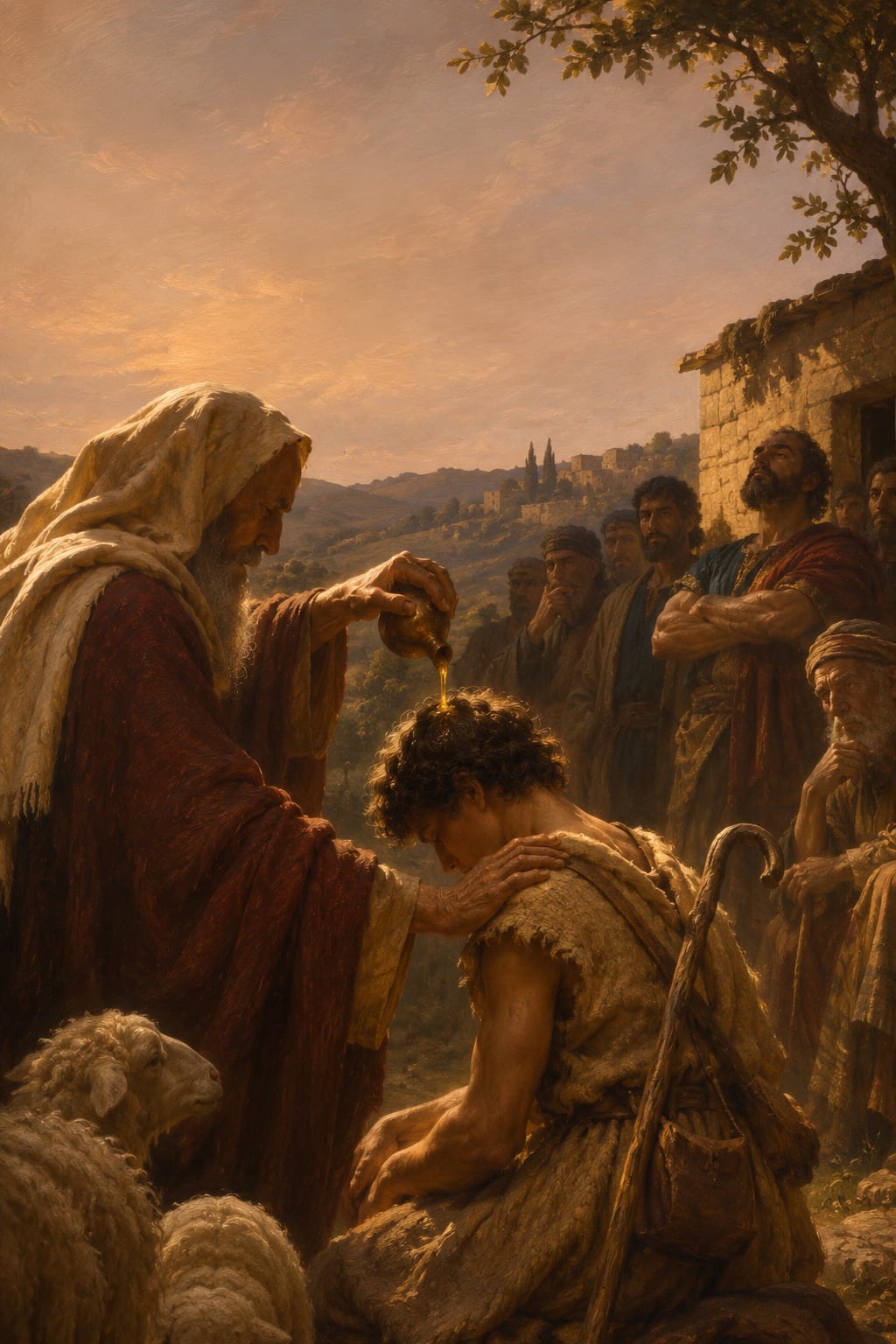
The Shepherd Nobody Sent For
1 Samuel 16:1-134 min
When God sent Samuel to anoint Israel's next king, He passed over every impressive candidate and chose a boy no one thought to invite. Scripture builds a consistent framework for evaluating people — not by résumé, but by root system.
Scripture
1 Samuel 16:1-13
Key moment 1 Samuel 16:7
Read
Samuel arrived in Bethlehem still grieving Saul, the tall, commanding king who looked the part and lost the plot. God's instruction was blunt: "Fill your horn with oil and go. I am sending you to Jesse of Bethlehem. I have chosen one of his sons to be king." When the eldest, Eliab, stepped forward — tall, striking, every inch a monarch — Samuel was certain. God stopped him cold.
"Do not consider his appearance or his height, for I have rejected him. The Lord does not look at the things people look at. People look at the outward appearance, but the Lord looks at the heart."
-- 1 Samuel 16:7
Seven sons passed. Seven rejections. Samuel, confused, asked Jesse if there was anyone else. Almost as an afterthought, Jesse mentioned the youngest — out with the sheep, unworthy of an invitation to the sacrifice. David wasn't hidden from God; he was hidden from everyone who relied on conventional metrics. The boy who fought bears and lions in anonymity, who wrote songs to God in empty fields, who was faithful when no one was evaluating him — that was the one God had been watching all along.
The Hebrew word for "heart" here is levav — not sentiment or emotion, but the deep seat of will, motive, and loyalty. God's evaluation method bypasses the lobby and goes straight to the engine room. David's heart wasn't perfect — his life would later prove that painfully. But it was oriented toward God, pliable, quick to repent. That orientation was the thing God valued above height, birth order, or battlefield experience.
Today
The biblical framework for evaluating people is remarkably consistent across both testaments, and it stands in sharp tension with nearly every system we default to. We scan for credentials, eloquence, confidence, platform size. We promote the charismatic and overlook the faithful. We mistake volume for authority and polish for substance.
Jesus gave a devastatingly simple diagnostic: "By their fruit you will recognize them" (Matthew 7:16). Not by their claims, their title, or the impressiveness of their entrance, but by what actually grows from their life over time. Proverbs 20:11 says even a child is known by their actions — character leaks early and consistently. And Paul's description of the Spirit's fruit in Galatians 5:22-23 reads less like a spiritual checklist and more like a portrait: love, joy, peace, patience, kindness, goodness, faithfulness, gentleness, self-control. When you're deciding who to trust, who to follow, who to hand authority to, that list is your rubric.
Consider who Jesus chose as his inner circle. He walked past the Sanhedrin and picked up fishermen. He called a tax collector from his booth. He invested authority in people whose primary qualification was a teachable heart. Luke 16:10 captures the principle beneath the pattern: "Whoever can be trusted with very little can also be trusted with much." Faithfulness in hidden, unglamorous, unobserved places — that is the biblical résumé. When you need to discern someone's character, don't ask what stage they've stood on. Ask what they do when no one is watching, how they treat people who can offer them nothing, whether their private life confirms or contradicts their public words. The fruit doesn't lie, and it doesn't hurry. Give it time, and it will tell you everything you need to know.
Pause
Take a slow breath.
Sit with what you've read.
Ponder
When you evaluate people — for trust, leadership, or friendship — what do you instinctively weigh first, and how does that compare to God's criteria in 1 Samuel 16:7?
Where in your own life are you being faithful in a hidden place, and how might God be using that season to form something others can't yet see?
Think of someone whose character fruit you've watched over time. What has that slow evidence taught you that a first impression never could?
Pray
A prayer
Father, Searcher of Hearts, forgive me for the times I have judged by appearance — drawn to what is impressive and blind to what is true. Teach me to see the way You see. Give me patience to watch for fruit rather than grabbing at first impressions, and wisdom to recognize faithfulness even when it comes without fanfare. Search my own heart, too. Where my private life doesn't match my public face, expose it gently and make me whole. Let me be someone whose roots go deep enough that the fruit speaks for itself. In Jesus' name.
Amen.
God sees what no résumé can show.The hidden faithful are never hidden from Him.