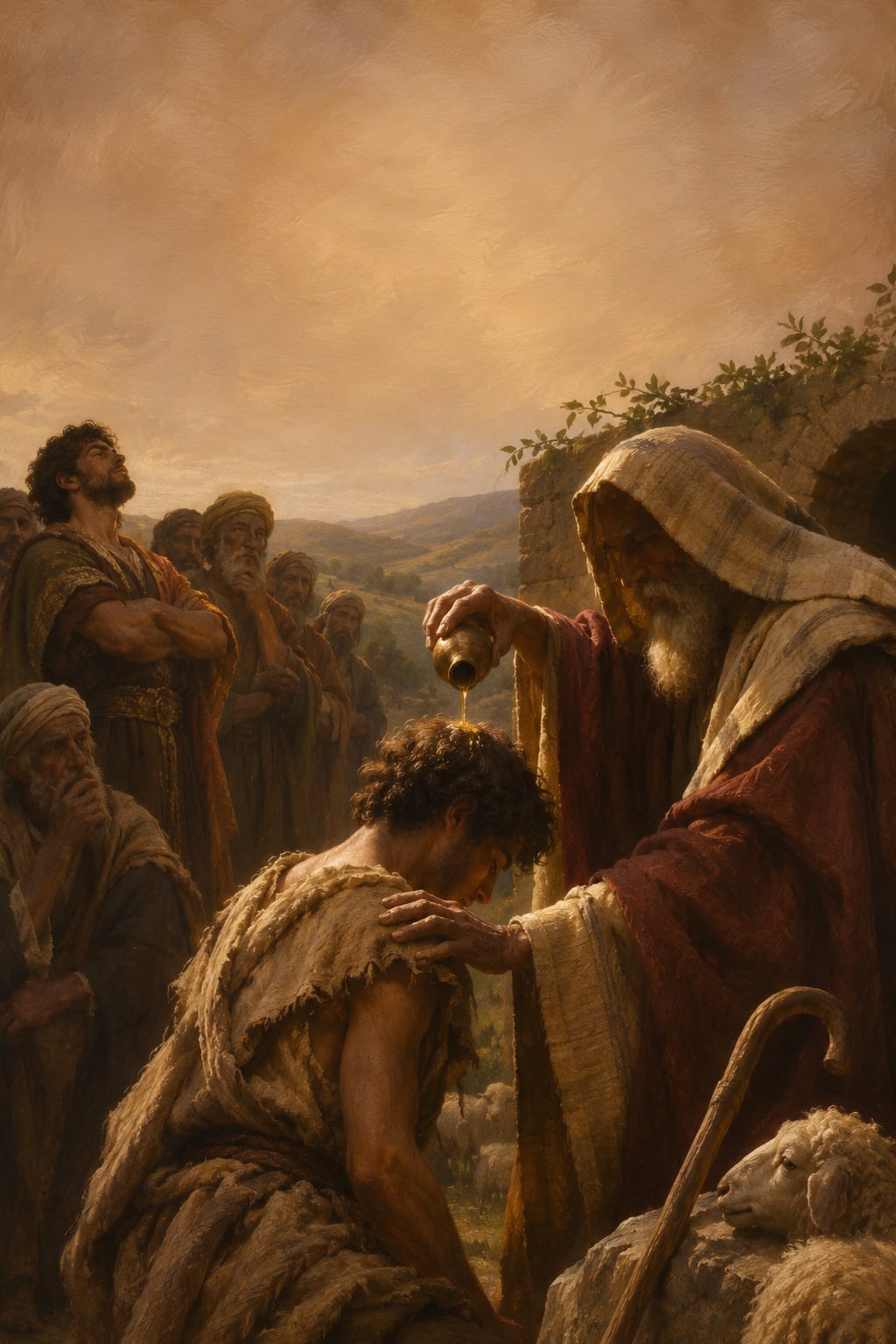
The Son No One Thought to Call
1 Samuel 16:1-134 min
When God sent Samuel to anoint Israel's next king, every visible indicator pointed to the wrong candidate. The story of David's anointing reveals that God evaluates people by a metric most of us never learn to read — and it changes how we should discern who to trust, elevate, and follow.
Scripture
1 Samuel 16:1-13
Key moment 1 Samuel 16:7
Read
Samuel arrived in Bethlehem still grieving Saul — the tall, commanding king who looked the part so completely that Israel's first impression had been unanimous. Now God was sending him to find a replacement, and Samuel carried a horn of oil and, almost certainly, the memory of how wrong the last choice had gone.
When Jesse's firstborn Eliab walked in, Samuel's breath caught. The text doesn't describe Eliab in detail, but it doesn't need to; Samuel's reaction tells us everything. "Surely the LORD's anointed stands here," he thought. The Hebrew word for "appearance" here is mar'eh — it's the same word used to describe Saul's impressive look in 1 Samuel 9:2. Samuel was pattern-matching. He saw height, presence, the bearing of a firstborn, and his mind leapt to a conclusion God had to interrupt: "Do not consider his appearance or his height, for I have rejected him. The LORD does not look at the things people look at. People look at the outward appearance, but the LORD looks at the heart."
What followed was a strange, almost comedic procession. Seven sons paraded before the prophet, and seven times: nothing. No fire from heaven, no whisper in Samuel's spirit. Jesse had apparently exhausted his roster. Samuel, confused, asked the question that cracks the whole story open: "Are these all the sons you have?" Jesse's answer is revealing — there's still the youngest, but he's out keeping the sheep. The Hebrew qatan means smallest, least significant. David wasn't being hidden maliciously; he simply didn't register as relevant. His own father didn't think the occasion warranted pulling him from the pasture.
Then David entered, ruddy and bright-eyed, and God said, "Rise and anoint him; this is the one." The Spirit of the LORD came powerfully upon David from that day forward. The king God wanted had been outside the room the entire time — not because he was being tested, but because no one considered him worth including.
Today
Most of us have been Samuel at some point, scanning a room and gravitating toward the person who carries the most visible authority. We assess competence by credentials, trustworthiness by confidence, leadership potential by how someone presents in the first five minutes. These aren't useless signals, but this story warns us they can function like a magnet pulling our judgment off-center. Samuel was a seasoned prophet, and Eliab fooled him instantly.
The practical challenge here runs deeper than "don't judge a book by its cover." God is retraining how Samuel evaluates people — and through this text, how we do the same. In leadership contexts, the question isn't just who looks capable? but who has been faithful when no one was watching? David's qualification wasn't charisma or stature. It was years of unnamed fidelity with sheep on a hillside, developing a heart that oriented toward God in obscurity. When you're deciding who to trust, who to elevate, who to align yourself with, look for the person whose character has been formed in the pasture, not just performed on the stage.
Notice too that David had to be sent for. The overlooked don't always advocate for themselves — that's part of what makes them overlooked. If your discernment only reaches people who are already in the room, already networking, already positioning themselves, you'll cycle through seven Eliabs and never find the one God is actually endorsing. Sometimes the most important act of leadership is asking Jesse's question in reverse: Who haven't we called yet?
Pause
Take a slow breath.
Sit with what you've read.
Ponder
When you evaluate people — for trust, partnership, or leadership — what qualities do you instinctively weigh most heavily, and how often do those map to visible profile rather than proven character?
Is there someone in your life who reminds you of David — faithful in obscurity, easy to overlook — whom you might need to see differently?
Where in your own life have you been shaped more by the 'pasture' seasons than the public ones, and how does that change how you understand your own worth?
Pray
A prayer
Father, the One who sees what is hidden and calls it more real than what is seen — forgive me for the times I have judged quickly by appearance, by credentials, by the confidence someone projects. My eyes are trained by a world that rewards surfaces. Retrain them. Give me the discernment Samuel needed that day in Bethlehem: the patience to wait through seven wrong answers, and the wisdom to ask who is still missing from the room. Let me value what You value. Shape my heart into the kind worth choosing, even if no one sends for me yet.
Amen.
You are seen where it matters most.The God who sent for the shepherd boy has not overlooked you.