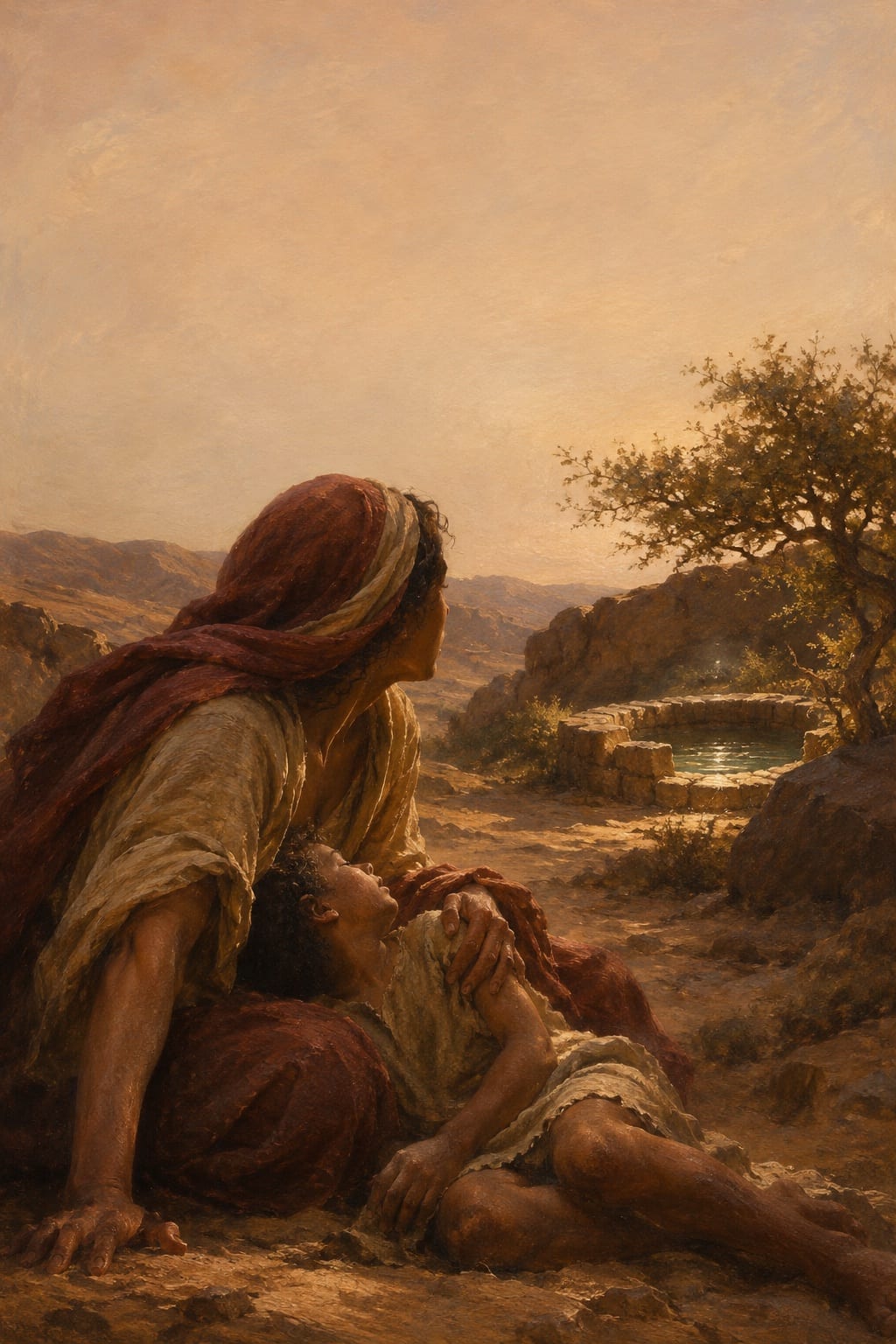
The Well That Was Already There
Genesis 21:14-215 min
Hagar collapses in the wilderness, certain her son will die, until God opens her eyes to a well that was there the whole time. For the depleted mother, provision is often something seen, not earned.
Scripture
Genesis 21:14-21
Key moment Genesis 21:17-19
Read
She walks until the water is gone.
Hagar has been put out by Sarah. Abraham hands her bread and a skin of water in the early morning, sets the boy on her shoulder, and sends her away. The Hebrew is plain about it: vayeshalcheha — and he sent her off. No provisions for the road ahead. No second skin. Just what she can carry, and a child she has nursed and carried since Egypt.
The wilderness of Beersheba is not metaphorical. It is dry scrub, white sun, hard ground. She wanders. The water runs out. And then comes the verse that mothers know in their bones:
She went and sat down opposite him at a distance of about a bowshot, for she said, Let me not look on the death of the child. And as she sat opposite him, she lifted up her voice and wept.
-- Genesis 21:16
A bowshot. The distance an arrow flies. Close enough to hear him. Far enough that she will not have to watch his small chest stop moving. This is not abandonment. This is a mother whose love has outlasted her strength. She cannot save him. She cannot nurse him back. She has nothing left in her body to give, and the only thing she can do for him now is refuse to witness what she cannot prevent.
The text says she lifted up her voice and wept. But the next verse pivots in a way easy to miss:
And God heard the voice of the boy, and the angel of God called to Hagar from heaven and said to her, What troubles you, Hagar? Fear not, for God has heard the voice of the boy where he is.
-- Genesis 21:17
God heard the boy. But God spoke to Hagar. He calls her by name — the second time in her story God does this. The first time, in chapter 16, she names him back: El Roi, the God who sees me. She is the only person in all of Scripture who gives God a name. And here he is again, finding her in another wilderness, calling her again by name.
Then comes the verb that changes everything. Vayifkach Elohim et eyneha — and God opened her eyes. She did not find the well. She did not crawl to it on her last reserves. She did not earn it through one more act of mothering. The well was already there. What she lacked was the sight to see it.
She fills the skin. She gives the boy a drink. The story ends with him growing up, becoming an archer, dwelling in the wilderness — the same wilderness that almost killed him becomes the place he learns to live. God is with the boy. God was with her. The well had been there the whole time.
Today
You are three weeks in, or six, or fourteen, and your body is doing the holiest work it has ever done. It is also leaking and sore and so tired that you cannot remember what your own face looks like in the mirror. You wonder, in the four-in-the-morning dark, whether this depletion is the price of love — whether real mothers are simply more capable than you, whether there is some secret you missed in a class you didn't take.
There is no secret. There is only the wilderness, and a body that has been spent for someone smaller than you.
Hagar's story does not promise the weariness will pass on a schedule. The text does not say God lifted her up and carried her home. He did not refill her water skin from heaven. He did not erase the desert. What he did was open her eyes to what was already nearby.
This is the part for you. The well in your wilderness is rarely something you have to manufacture by your own depleted strength. It is usually something already placed within reach that you cannot see because you are too tired to look up. The friend who texted yesterday and meant the offer. The forty minutes of sleep your partner can take if you ask. The meal in the freezer your mother labeled. The pediatrician's nurse line. The hot shower at 9pm. The permission to stop washing the bottles tonight.
God is not asking you to be stronger than Hagar. He is the same God who heard the cry and called her by name and opened her eyes. He sees you in this wilderness. He knows the bowshot you have walked because you cannot bear another minute of watching what feels impossible. The depletion is not a sign you are failing at worship. The depletion is the worship. And the same God who counted Hagar's tears is asking you, gently, to look up.
The well is already there. You do not have to dig it. You only have to be shown it.
Pause
Take a slow breath.
Sit with what you've read.
Ponder
Where in your weariness right now have you been so focused on what you cannot do that you have not yet seen what is already within reach?
Who has God already placed nearby — a person, a resource, a small mercy — that you have not let yourself receive?
What would it mean to believe that God hears your child's cry, and yours, even when you have nothing left to offer?
Pray
A prayer
God who sees me, God who hears, you know my name in this wilderness. You know the bowshot I have walked because I am too tired to watch one more thing I cannot fix. My body is spent. My eyes are heavy. I have given what I had and there is still more being asked of me. I am not asking you to make the desert disappear. I am asking what Hagar received without asking — open my eyes. Show me the well already here. The help I have been too proud or too exhausted to take. The rest that is available if I will accept it. The mercy already placed within reach of my hand. Let me hear you call me by name. Let me trust that the depletion of love is not failure but offering. And give me the small grace, today, of seeing what you have already provided.
Amen.
Look up, beloved.The well is already there.