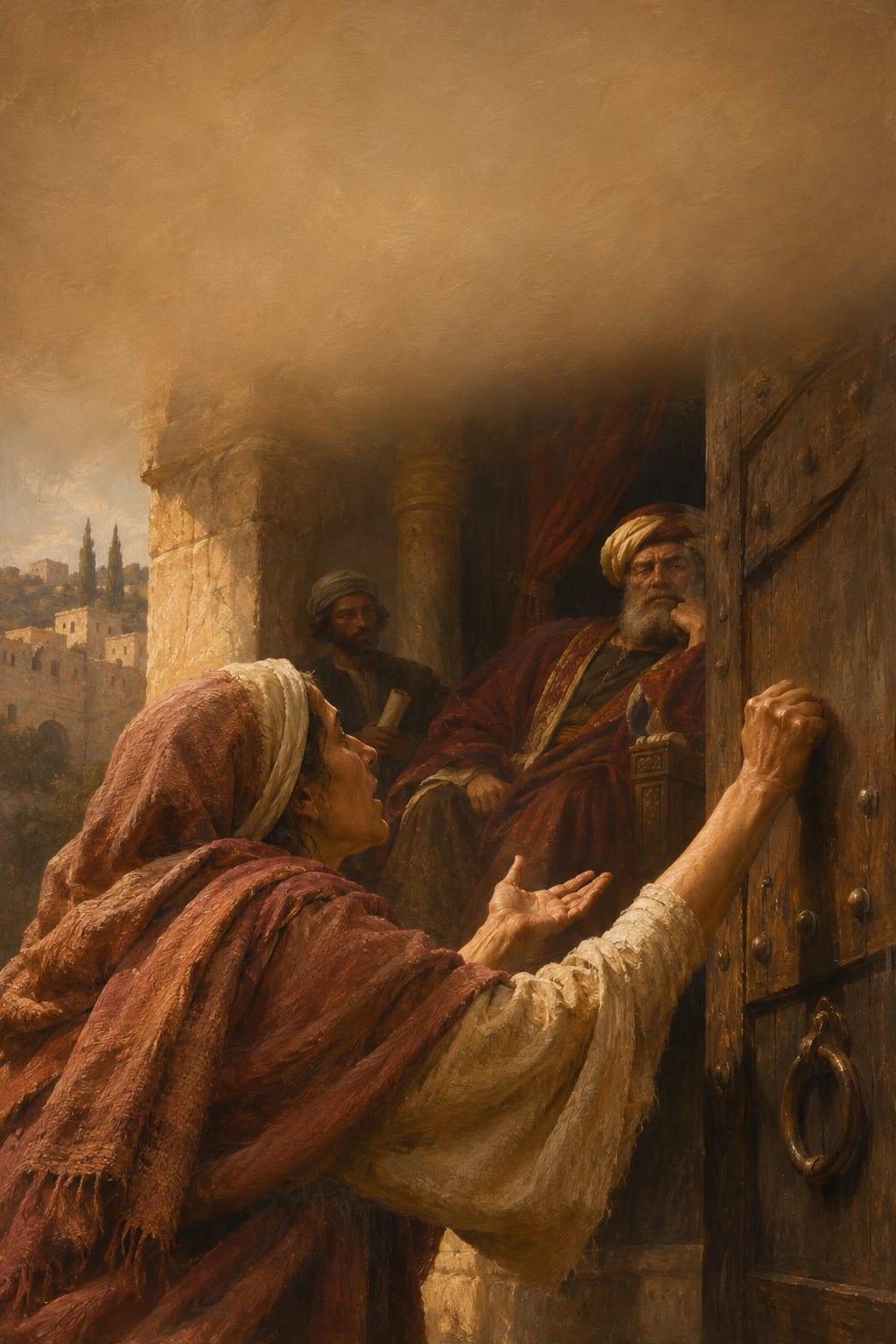
The Widow Who Wouldn't Stop Knocking
Luke 18:1-83 min
Jesus tells a strange story about a widow who keeps showing up at an unjust judge's door. The story is not really about her stamina; it is about whether we will keep coming when the answer is delayed.
Scripture
Luke 18:1-8
Key moment Luke 18:7-8
Read
Picture her: a widow in a town with no welfare, no advocate, no one to walk her to court. The man across the bench owes her nothing. Luke tells us he neither feared God nor cared what people thought (Luke 18:2), which is the kind of judge no one wants to face alone. She has no leverage, no bribe, no family name to drop. She has only her voice and her feet, and she uses both.
She comes. She comes back. She comes again. The Greek verb Luke uses for kept coming is iterative; she did not file a single petition and wait. She wore a path to his door. Eventually the judge mutters to himself,
Because this widow keeps bothering me, I will see that she gets justice, so that she won't eventually come and attack me.
-- Luke 18:5
He yields not to mercy but to fatigue.
Then Jesus pivots in a way that should make us nervous. Listen to what the unjust judge says, he says. The whole parable runs on contrast. If a corrupt man bends to persistence, how much more will the Father, who loves you, answer his children when they cry to him day and night.
Notice what Jesus is careful not to say. He does not claim the widow wore down the judge's heart; she only wore down his patience. Persistence here is presence, not leverage. The Father is already inclined toward his children. The widow's job, and ours, is simply to keep coming.
The parable's real punch lands in verse 8, almost as an afterthought:
However, when the Son of Man comes, will he find faith on the earth?
-- Luke 18:8
The question is not whether God will act. The question is whether we will still be there when he does.
Today
You probably have a prayer that has gone quiet. A name you used to say nightly. A request you have stopped expecting an answer to. Somewhere along the way, the silence began to feel like a verdict.
Jesus knew this would happen. Luke tells us up front why he told this story, to show them that they should always pray and not give up (Luke 18:1). He did not tell it because prayer is easy. He told it because it isn't.
What if showing up is the prayer? Not the eloquent words, not the right amount of feeling, just the act of bringing yourself back into the room. The widow had no theology of intercession. She had a need and a door, and she kept matching the two.
The freedom here is small and real. You do not have to pray better or louder. You only have to keep coming back. The Father who loves you is not the judge in this story; he is the contrast to him. He is already inclined toward you. Your part is to keep being someone who still asks.
Pause
Take a slow breath.
Sit with what you've read.
Ponder
What prayer have you stopped saying out loud, and what made you stop?
If God is the contrast to the unjust judge, not his echo, how does that change the way you approach him today?
What would it look like to come back to one prayer this week, not louder, just present?
Pray
A prayer
Faithful Father, the One who hears, We come because you are good, not because we have made our case well. Hallowed is your name, even in the long quiet. May your kingdom come into the places we have stopped asking about. May your will be done in the silences we have learned to live with. Give us today the grace to come back. Forgive us for assuming the silence was a no. Forgive us when we mistook our weariness for your absence. Lead us not into the temptation to stop knocking, and deliver us from the lie that you are reluctant. Find us still here when you come. Find us, even when our prayers are one syllable long, still bringing them. Yours is the kingdom, the patience, and the love that outlasts our doubt.
Amen.
Keep coming back.He is a Father who hears.