Though the Fig Tree Does Not Blossom
Habakkuk 1:1-4; 2:1-4; 3:16-194 min
Habakkuk begins his book by asking God how long He will stay silent, and ends it singing over empty fields. His journey shows that faith can name every loss and still rejoice, because its joy and strength come from God Himself.
Scripture
Habakkuk 1:1-4; 2:1-4; 3:16-19
Key moment Habakkuk 3:17-19
Read
Habakkuk's book opens with a complaint.
O LORD, how long shall I cry for help, and you will not hear?
-- Habakkuk 1:2
He was a prophet in Judah in the last years before Babylon invaded. He looked around and saw violence, injustice, and courts that bent the law, and he could not understand why God allowed it. So he asked. Most prophets bring God's words to the people. Habakkuk spends his book bringing his own questions to God.
God's first answer made things worse. He said He was raising up the Chaldeans, a fierce and ruthless nation, to sweep through the land. Habakkuk protested. Then he did something worth noticing. He climbed his watchtower and waited to see what God would say. He did not walk away from the conversation.
God's second answer contains a line the New Testament quotes three times.
The righteous shall live by his faith.
-- Habakkuk 2:4
No date was given and no rescue promised. Judgment on Babylon would come in its time. Until then, God's people would live by trusting Him.
---
Chapter three is Habakkuk's response, written as a song. He is not pretending to be calm. He says his body trembles, his lips quiver, and his legs give way beneath him. The invasion is still coming.
Then he makes a list. For a farming people it is a list of total ruin, moving from luxuries to necessities.
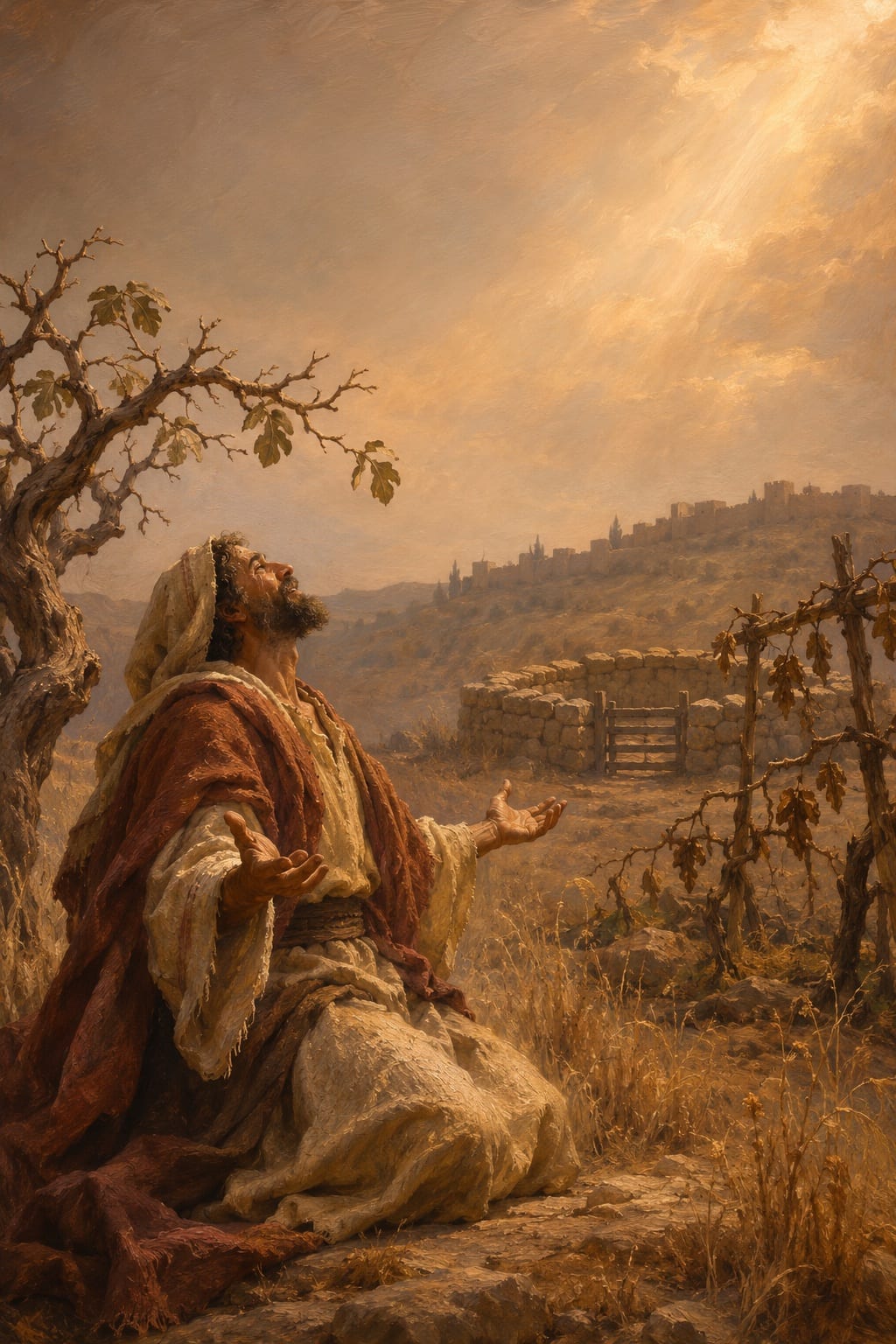
Though the fig tree should not blossom, nor fruit be on the vines, the produce of the olive fail and the fields yield no food, the flock be cut off from the fold and there be no herd in the stalls, yet I will rejoice in the LORD; I will take joy in the God of my salvation.
-- Habakkuk 3:17-18
Figs and grapes were the sweetness of life. Olives meant oil for cooking and light. Grain was bread. Flocks and herds were a family's savings. He imagines all six gone, the whole economy empty, and then writes the word yet.
His joy has an object. He rejoices in the LORD. The barns are empty and he does not claim to be glad about that. He has found a source of gladness that the Chaldeans cannot carry off.
He closes with an image of a deer on a mountainside. GOD, the Lord, is my strength; he makes my feet like the deer's. The ground is steep and dangerous, and God gives him sure footing on it. The man who began with how long ends by handing his song to the choirmaster.
Today
This week we have watched people depend on God and see Him act. A widow's jars were filled. A siege was lifted. A boy was healed, a garrison fell, and three men walked out of a fire. Habakkuk belongs at the end because his story tells the truth about the days when none of that has happened yet.
Some seasons are fig-tree seasons. The income has not come. The healing has not come. The prayer you have prayed for years is still unanswered, and the news seems to be getting worse. Habakkuk gives such seasons a language. You are allowed to ask how long. You are allowed to tremble. Honest complaint brought to God is a form of faith, because you are still talking to Him.
He also shows where that honesty can lead. Try writing your own version of his list. Though the job does not come, though the account stays low, though the house is quiet... Name each thing. Then decide what comes after your yet.
This is where dependence on God arrives in the end. We rely on Him for bread, for rescue, for direction. Beneath all of those, we rely on Him for Himself. When God is our joy and our strength, we have something that scarcity cannot reach. Gifts may come and go with the seasons. The Giver remains.
Habakkuk did not escape the hard years. He received feet for the mountain. God may change your circumstances, and you should keep asking Him to. While you wait, He offers you strength for the ground you are standing on and a joy with roots deeper than the harvest.
Pause
Take a slow breath.
Sit with what you've read.
Ponder
What would your own "though..." list include right now?
What helps you rejoice in God Himself when His gifts seem to be missing?
As this week on faith ends, which story has changed the way you want to depend on God?
Pray
A prayer
GOD, the Lord, our Strength and the God of our salvation, You remain when everything else fails, and Your name is holy. Let Your kingdom come and Your will be done in our land and in our home, as it is in heaven. Give us today our daily bread, and where the fields are empty, give us Yourself. Forgive us for loving Your gifts more than we have loved You. Keep us from bitterness in the waiting. Deliver us from the day of trouble, and until then make our feet like the deer's on the high places. Though the fig tree does not blossom, yet we will rejoice in You.
Amen.
Walk on the heights.God is your strength.