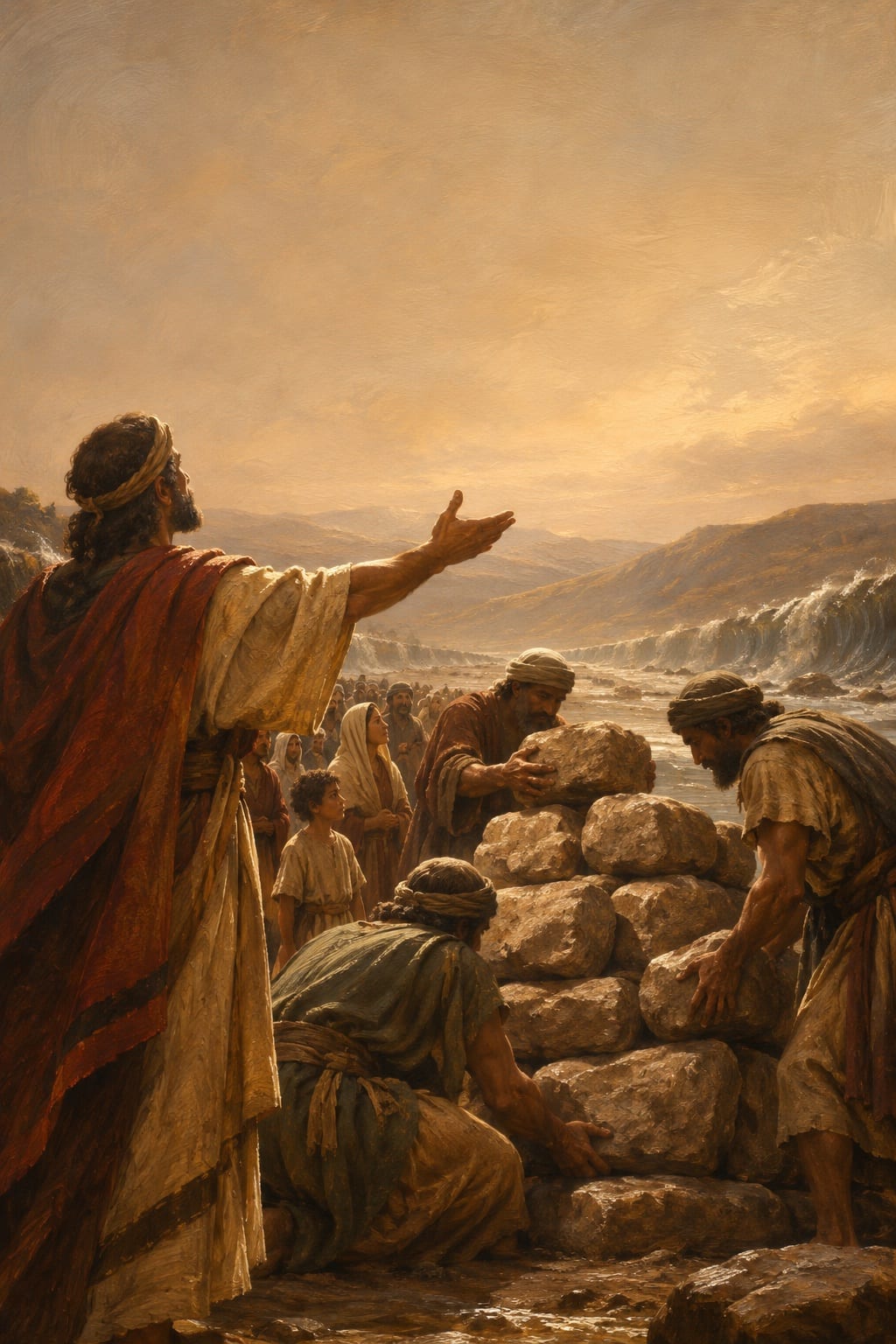
Twelve Stones from the Riverbed
Joshua 3:14 – 4:244 min
After God parts the Jordan River, He commands Israel to stack twelve stones as a memorial — a physical anchor for a spiritual truth: what God has done is the surest evidence of what He will do.
Scripture
Joshua 3:14 – 4:24
Key moment Joshua 4:6-7
Read
The Jordan was at flood stage. That detail matters — it wasn't a gentle crossing, not a shallow ford where the water lapped at their ankles. The river had swollen past its banks, fed by spring melt, and the entire nation of Israel stood at its edge with everything they owned. Behind them, forty years of wilderness. Ahead, a land full of fortified cities and armies who knew they were coming. And between them and all of it, a river they could not cross.
Then the priests stepped in. Their feet touched the water and the river stopped, heaped up in a wall far upstream at a town called Adam. The people crossed on dry ground — not mud, not silt, but solid footing in the middle of a riverbed that had been roaring moments before. God didn't give them a bridge or a shallow detour. He stopped the river entirely, as if to say: I want you to walk through the place that frightened you and feel nothing beneath your feet but stone.
What happened next is the part we often skip. God told Joshua to send twelve men back into the empty riverbed, one from each tribe, and to have each man lift a stone from the place where the priests' feet stood. They carried those stones to their camp at Gilgal and stacked them. Joshua explained the purpose plainly:
"In the future when your descendants ask their parents, 'What do these stones mean?' tell them, 'Israel crossed the Jordan on dry ground.'"
-- Joshua 4:21-22
The memorial wasn't decorative. It was a tool for the hard conversations ahead — for the seasons when the children of Israel would face their own rivers and wonder if God had forgotten them. The stones didn't prove anything on their own; they were ordinary rocks from a riverbed. But they held a story, and the story held the faithfulness of God. That was enough.
Today
There's a pattern in Scripture that's easy to miss: God consistently asks His people to name what He has done before He calls them into what comes next. The Passover meal before the exodus. The manna jar kept in the ark. Twelve stones before the battles of Canaan. Remembrance isn't nostalgia; it's preparation.
Most of us carry our own riverbed stones, even if we've never stacked them. A phone call that changed everything. A provision that arrived with timing too precise to explain away. A relationship restored when restoration seemed impossible. A diagnosis that reversed, a door that opened, a moment when the ground beneath your feet held firm despite every reason it shouldn't have. These moments are easy to forget — not because they weren't significant, but because life keeps moving and the next challenge absorbs our attention.
The practice God invites here is simple and concrete: name them. Write them down, tell someone, return to them deliberately when fear rises. Not as a formula to guarantee the same outcome, but as honest evidence that you have never once been abandoned. The next Jordan will look impassable. It always does. But you've stood on dry ground before, and the God who stopped the river upstream hasn't retired.
Your stones don't need to be dramatic to be real. Sometimes the most anchoring memory is a quiet one — a morning you woke up and realized the despair had lifted, a season of provision so ordinary you almost missed it. Stack those too. They count.
Pause
Take a slow breath.
Sit with what you've read.
Ponder
What are two or three moments in your life where God's provision was unmistakable — and when did you last revisit them deliberately?
Is there a current challenge that feels like a flooded river? How might remembering a past deliverance change the way you approach it?
Who in your life needs to hear the story behind one of your stones?
Pray
A prayer
Father, God of the Jordan and every river since — I praise You for being the same yesterday, today, and forever. Your kingdom comes not through my certainty but through Your faithfulness, and I ask that Your will be done in the places where I cannot see the way forward. Forgive me for the speed with which I forget what You have done. I confess that I have let fear narrate my future more often than memory has anchored it. Teach me to stack my stones. Bring to mind the moments I have overlooked or taken for granted, and give me the courage to trust that the God who stopped the river is the God who walks with me still.
Amen.
Stack your stones.What God has done is the truest map for where He is leading.