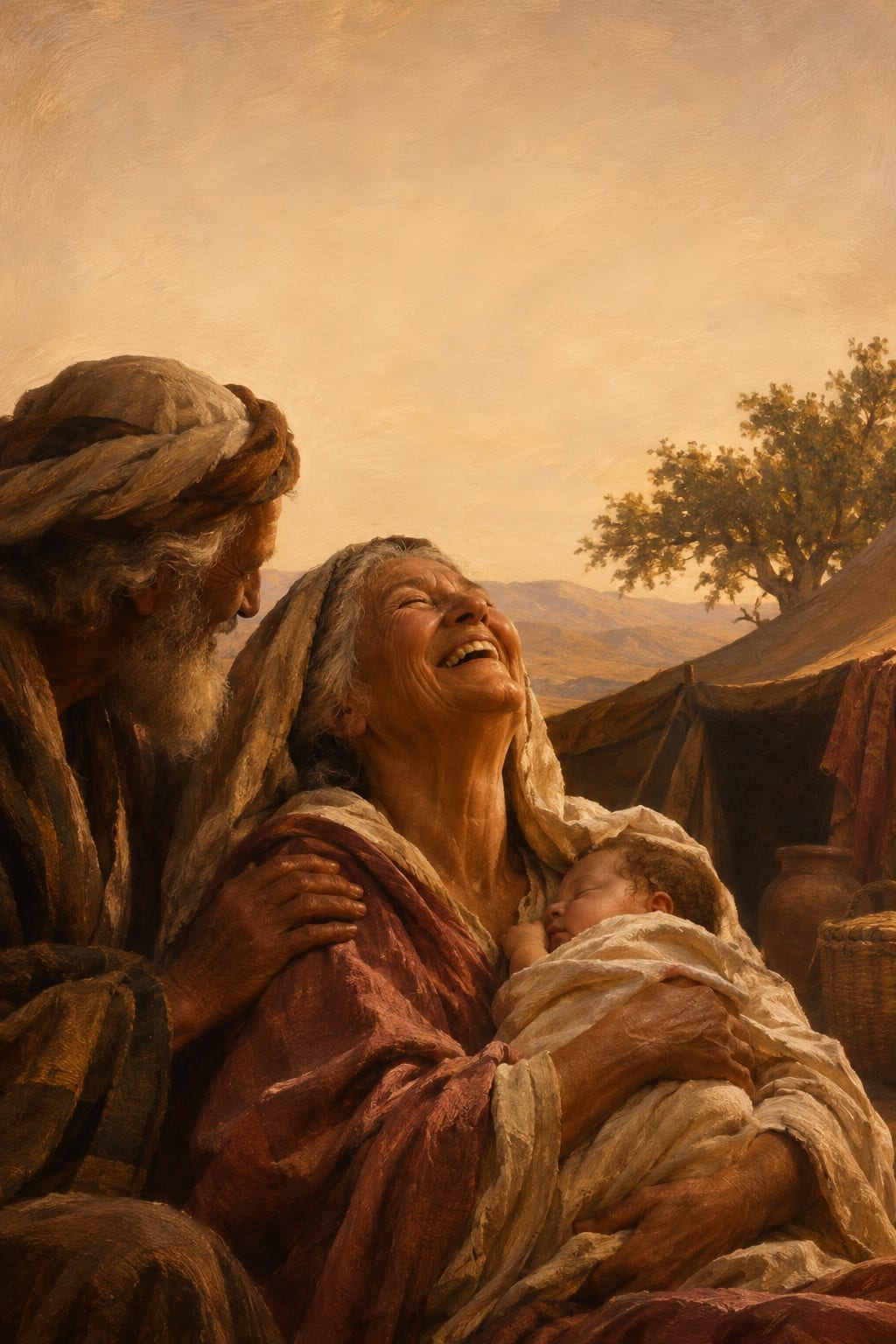
When Sarah Finally Laughed
Genesis 21:1-76 min
Sarah waited decades for a promise that arrived in her ninetieth year. Her story gives language to every woman holding ambitions that didn't disappear just because a new season did.
Scripture
Genesis 21:1-7
Key moment Genesis 21:6-7
Read
Sarah is ninety years old when she finally holds her son.
Think about that for a moment. She has been waiting for this child since she was sixty-five, when God first spoke to her husband about a great nation coming from his body. Twenty-five years of monthly disappointment. Twenty-five years of watching other women's bellies grow round while hers stayed flat. Twenty-five years of being the woman whose name meant princess with no heir to her throne.
She had tried to help God along the way. The Hagar plan. The bitter laugh in the tent doorway when three strangers said next year. By the time the angels came, Sarah had stopped believing the promise belonged to her body. She belonged to the dream by association, not by participation.
Then Genesis 21 opens with one of the most quietly devastating sentences in Scripture: The Lord visited Sarah as he had said, and the Lord did to Sarah as he had promised. The Hebrew word for visited is paqad — to attend to, to take notice of, to act on behalf of. After decades of what felt like divine forgetting, God paqad her. He showed up at the exact appointed time. Not earlier, when it would have been easier. Not later, when she could have framed it as adoption or metaphor. At ninety, when only God could get the credit.
And then she laughs.
God has made laughter for me; everyone who hears will laugh over me.
-- Genesis 21:6
This is a different laugh than the one in the tent. That earlier laugh was thin and protective, the laugh of a woman defending herself from hope. This laugh is wide. It has the texture of someone who has been emptied so long that being filled feels comedic. Who would have said to Abraham that Sarah would nurse children? she asks. The Hebrew can be read as a genuine question. She is still surprised. She is still holding the baby like she might wake up.
The text never apologizes for the timing. It does not explain why God waited. It simply records that He did what He said He would do, in the body He said He would do it in, and that the woman who had stopped expecting it laughed when it arrived.
The dream did not die in the waiting. It just arrived on a calendar Sarah did not write.
Today
You are three weeks into being someone's mother, and the dream you carried before the baby is still in you.
Maybe it is a book you were going to write. A business that was finally finding its shape. A degree halfway finished. An idea you used to talk about with such heat that your friends would tell you to go do that thing already. Now you are nursing in the dark at 3 a.m., and the thought surfaces uninvited: when? And right behind it, a quieter, more shaming thought: should I even be wanting this right now?
You love this baby. That is not in question. What is in question is whether the rest of you is allowed to still exist in this season, or whether being a good mother requires you to file your ambitions in a box marked later and pretend you do not hear them knocking.
Sarah's story does not give you a timeline. It does not promise that your book will be published by the time the baby walks, or that your business will launch when the toddler starts preschool. What it gives you is something better: permission to keep the dream alive without demanding it arrive on your schedule. Sarah did not stop being a woman with a promise during the twenty-five years she was not yet a mother. The promise lived in her even when it looked dormant. God did not ask her to amputate the longing in order to be faithful in the waiting. He asked her to keep being who she was while He worked out the timing she could not see.
Wanting the dream is not unfaithfulness to the baby. It is evidence that God put something in you that a single season cannot exhaust. The same God who gave you this child gave you those ambitions. He is not embarrassed by them. He is not asking you to choose between the milk-stained shirt and the calling. He is asking you to trust that the One who kept His word to a ninety-year-old woman knows exactly when to paqad you.
So when the dream knocks at 3 a.m., you do not have to silence it. You can name it. You can hand it back to God like Sarah handed her swaddled son to the village. You can say, this is still mine, and I am still Yours, and I will laugh when You bring it. The waiting is not the death of the dream. It is the place where the dream learns to belong to God before it belongs to you.
Pause
Take a slow breath.
Sit with what you've read.
Ponder
What is the specific dream you are holding right now that has not gone away just because this baby has arrived?
Where have you been treating wanting it as evidence of unfaithfulness, instead of evidence that God put something real in you?
What would it look like this week to keep that dream alive with God rather than wrestling Him for the timing?
Pray
A prayer
Faithful God who keeps promises across decades, You are the One who visited Sarah at ninety, who did exactly what You said in the body of a woman who had stopped expecting it. You are not late. You have never been late. Your timing is not my timing, and I am learning that this is mercy, not cruelty. I bring You the dream I am still carrying. The one that did not disappear when this baby arrived. You know what it is. You put it in me before I knew this child's face. I confess I have been afraid that wanting it makes me a worse mother, that holding it means I am not grateful for what You have already given. Forgive me for treating Your gifts as though they cancel each other out. Let Your kingdom come in this season, the small kingdom of nights and feedings and the larger kingdom of the calling You are not finished with. Keep the dream alive in me without letting it become a god. Teach me to hand it to You every morning and trust that You remember it more clearly than I do. When the time comes, give me Sarah's laugh. The wide one. The one that knows only You could have done it.
Amen.
Go gently into this day.The dream is not dead. It is held.