Fed by Ravens, Sustained by a Stranger
1 Kings 17:1-163 min
Elijah's journey from the brook Cherith to the widow's home in Zarephath reveals a God who provides in ways that unsettle our pride — through unclean birds, through people who have almost nothing, and through jars that stay just barely full.
Scripture
1 Kings 17:1-16
Key moment 1 Kings 17:14-16
Read
Elijah had just delivered the boldest prophecy of his career — no rain until he said so — and God's next instruction was to hide. Not to build, not to rally troops, not to ride the momentum. Hide by a brook. And wait for ravens.
Consider what that actually meant. Ravens were unclean animals under Levitical law. A prophet of Israel, eating bread and meat from the beaks of scavengers — it was provision, but the kind that would make a religious person flinch. God was already training Elijah in something essential: you do not get to dictate the packaging of my care for you. The brook did its work. And then the brook dried up.
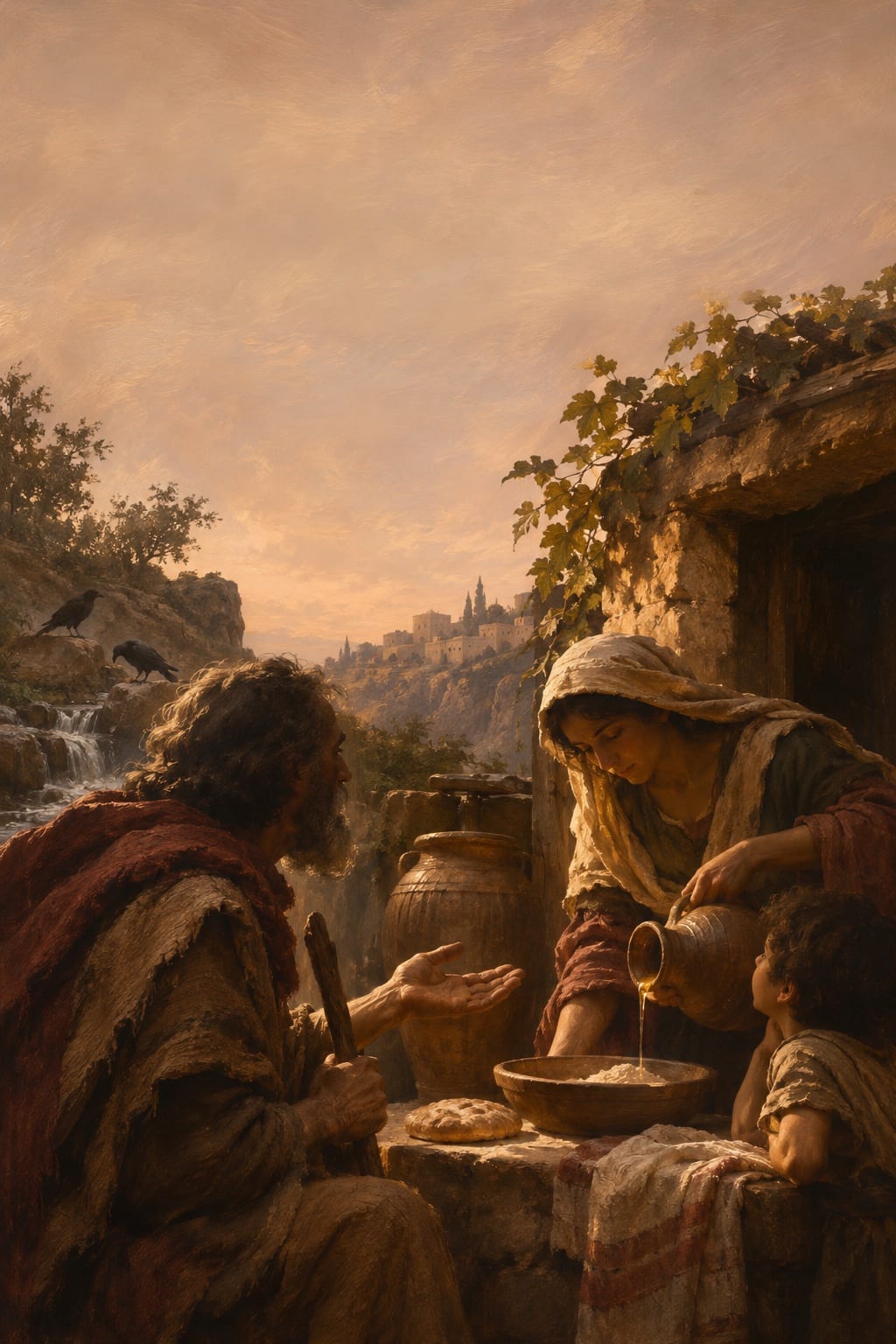
God's next provision was even more disorienting. He sent Elijah to Zarephath, a Sidonian town — Jezebel's home territory — and told him a widow would feed him there. When Elijah arrived, the widow was gathering sticks to cook a final meal for herself and her son before they starved. This was the provider God had chosen. Not a wealthy patron, not a king sympathetic to the cause, but a woman scraping the bottom of a jar. Elijah asked her to feed him first, and she did. The text says it plainly:
The jar of flour was not used up and the jug of oil did not run dry, in keeping with the word of the LORD spoken by Elijah.
-- 1 Kings 17:16
Notice what didn't happen. The jar was never overflowing. The oil never multiplied into surplus. There was enough — day after day, just enough. God sustained a prophet and a destitute family through a provision that required them to reach into the jar again every single morning, never knowing by sight whether tomorrow's portion would be there. The miracle lived inside the repetition, not above it.
Today
Most of us are more comfortable giving than receiving. There is a particular vulnerability in needing something from someone who doesn't seem to have much to spare — a friend already stretched thin, a community we feel guilty asking, a resource that seems too humble to count. We'd prefer God send provision through obvious channels, wrapped neatly, requiring no awkwardness.
But the Cherith-to-Zarephath pattern suggests God often works differently. He routes his care through unlikely people and uncomfortable arrangements because the provision itself is only half the gift. The other half is what happens inside us when we let someone feed us — when we stop performing self-sufficiency and admit we are hungry. Elijah, the man who shut the sky, had to sit by a creek and let birds bring him dinner. Then he had to ask a starving woman for bread. His prophetic authority did not exempt him from dependence.
You might be in a season where the brook has dried up — where something that sustained you is no longer there, and what God seems to be offering instead feels inadequate or embarrassing. Pay attention to the jar-and-jug kind of provision: enough for today, given through hands you wouldn't have chosen. It may not look like abundance, but it hasn't run out yet. And the fact that it comes through other people isn't a flaw in the system. It's the design.
Pause
Take a slow breath.
Sit with what you've read.
Ponder
Where in your life right now is God providing just enough — and how do you feel about the 'just' part?
Is there help being offered to you that you've resisted because of how it's packaged or who it comes from?
What would it look like to receive without apologizing for the need?
Pray
A prayer
Father, Provider of manna and oil and breath itself — I confess that I often want your provision on my terms. I want abundance I can measure and sources I can respect. Forgive my pride when it masquerades as independence. Give me the courage to receive what you send through hands I wouldn't have chosen. Let your kingdom come in the daily, unspectacular miracle of enough. Teach me that depending on others is not weakness but worship — a way of trusting that you are at work in the ordinary jar, the ordinary day, the ordinary kindness I almost overlooked.
Amen.
The jar is not empty yet.He provides — one day, one handful, one unlikely kindness at a time.