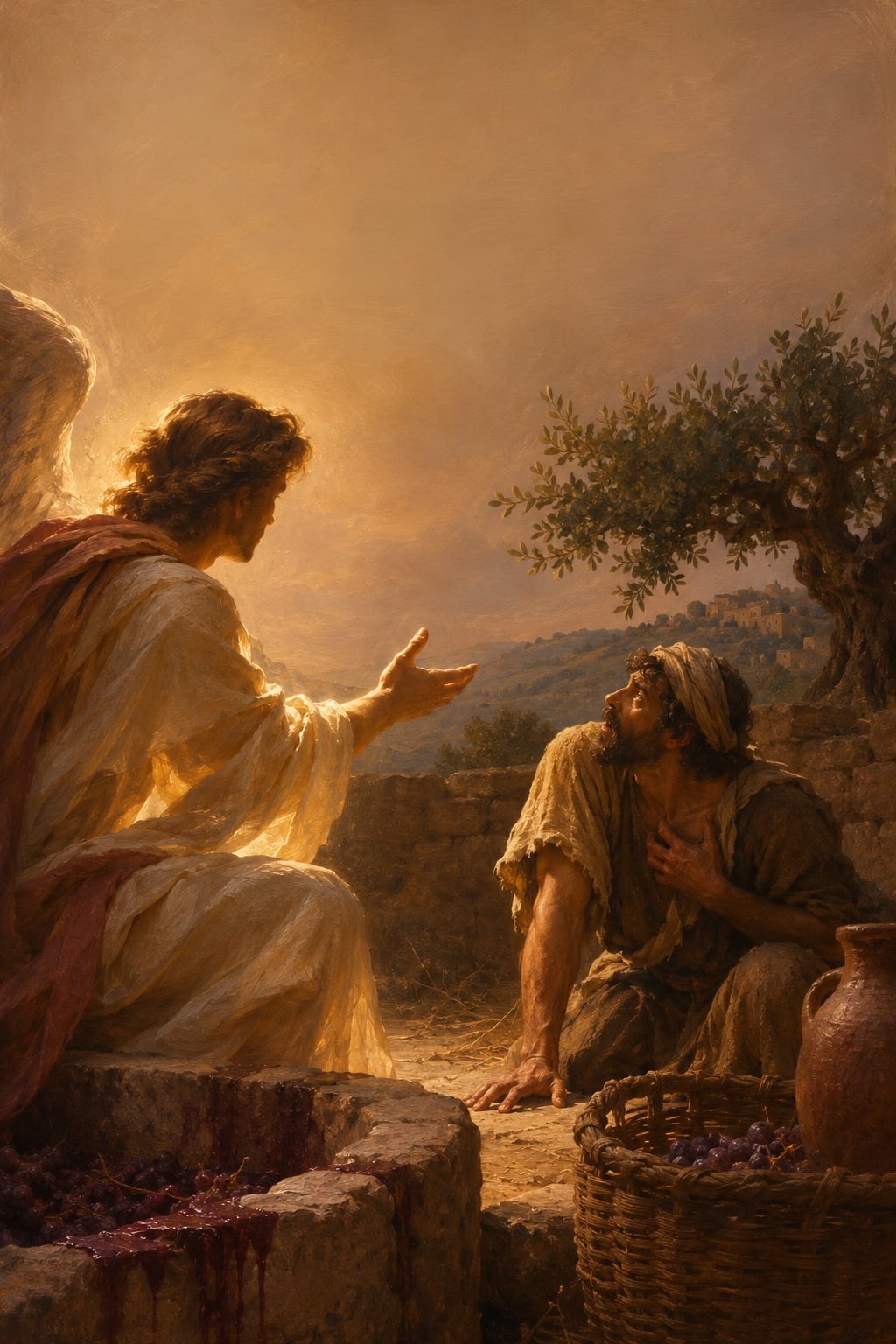
The Warrior in the Winepress
Judges 6:1-244 min
When the angel of the Lord greets a frightened farmer as a mighty warrior, we learn that God names us according to what He is about to do through us — not according to how we feel about ourselves.
Scripture
Judges 6:1-24
Key moment Judges 6:12-16
Read
Gideon is threshing wheat in a winepress. That detail matters more than it first appears. Winepresses are low, cramped, hidden — the opposite of a threshing floor, which sits on a hilltop where wind separates chaff from grain. Gideon has chosen concealment over efficiency because the Midianites have terrorized Israel for seven years, stripping fields and slaughtering livestock until the people are hollowed out. He is doing the right work in the wrong place, driven underground by fear.
Into this scene steps the angel of the Lord, who sits beneath an oak tree and delivers one of Scripture's most jarring greetings: "The Lord is with you, mighty warrior" (Judges 6:12). The Hebrew is gibbor hechayil — a phrase reserved for men of valor, strength, and standing. Gideon's response is sharp and honest. He doesn't accept the title. He pushes back: if God is with us, why has all this happened? Where are the miracles our ancestors told us about? He then offers his résumé of inadequacy — his clan is the weakest in Manasseh, and he is the least in his family.
God does not argue with Gideon's self-assessment. He simply redirects: "Go in the strength you have and save Israel out of Midian's hand. Am I not sending you?" (6:14). The phrase "Am I not sending you" carries the full weight of the commission. God never says Gideon is wrong about his weakness. He says the weakness is irrelevant, because the sending is what matters. The source of the mission reshapes the identity of the messenger.
Gideon asks for signs — the fleece, twice — and God grants them without rebuke. There's a patience here worth noticing. God meets Gideon's doubt not with disappointment but with demonstration, confirming the call through fire that consumes an offering on rock (6:21) and through dew on wool. By the chapter's end, Gideon builds an altar and names it Yahweh Shalom — "The Lord is Peace." The man who began in hiding ends by marking the ground where fear gave way to presence.
Today
Most of us know what it feels like to thresh wheat in a winepress — doing necessary work from a posture of smallness, keeping our heads down, hoping the threat passes. We shrink our ambitions to match our anxieties. We rehearse our disqualifications so fluently that they start to sound like wisdom: I'm not experienced enough, not connected enough, not the right person.
Gideon's story confronts that logic at its root. God didn't wait for Gideon to feel brave before calling him a warrior. The name came first, before the battles, before the army, before the trumpet and the clay jars. Identity, in God's economy, precedes performance. He speaks to who you are becoming, not to who you think you've been.
This doesn't mean courage arrives all at once. Gideon asked for proof — more than once — and God gave it without shaming him. If you need reassurance, that isn't failure. The willingness to keep asking, to stay in the conversation even while afraid, is itself a kind of valor. Gideon's courage didn't come from finally believing in himself. It came from slowly, stubbornly believing that the One who sent him would also sustain him.
Wherever you feel least qualified today, consider that God may be sitting at the edge of that exact place, calling you something you haven't yet learned to answer to. The winepress isn't your identity. The name He gives you is.
Pause
Take a slow breath.
Sit with what you've read.
Ponder
What "winepress" have you been hiding in — what work or calling have you scaled down because fear seemed more reasonable than faith?
When you rehearse your disqualifications, whose voice are you actually echoing — and what might God's name for you sound like instead?
Where in your life is God inviting you to go "in the strength you have" rather than waiting until you feel fully ready?
Pray
A prayer
Father, mighty God who sees what is still becoming, Your kingdom comes even into winepresses and hiding places. Your will unfolds through the unlikely and the overlooked. I confess that I have mistaken my fear for truth and let it name me. I have waited to feel strong before stepping forward, forgetting that You never asked me to go in my own strength. Speak my true name again. Send me, and let Your sending be enough. Give me today what today requires, and guard me from borrowing tomorrow's fears. You are my peace — Yahweh Shalom — even here.
Amen.
Go in the strength you have.He who sends you will sustain you.