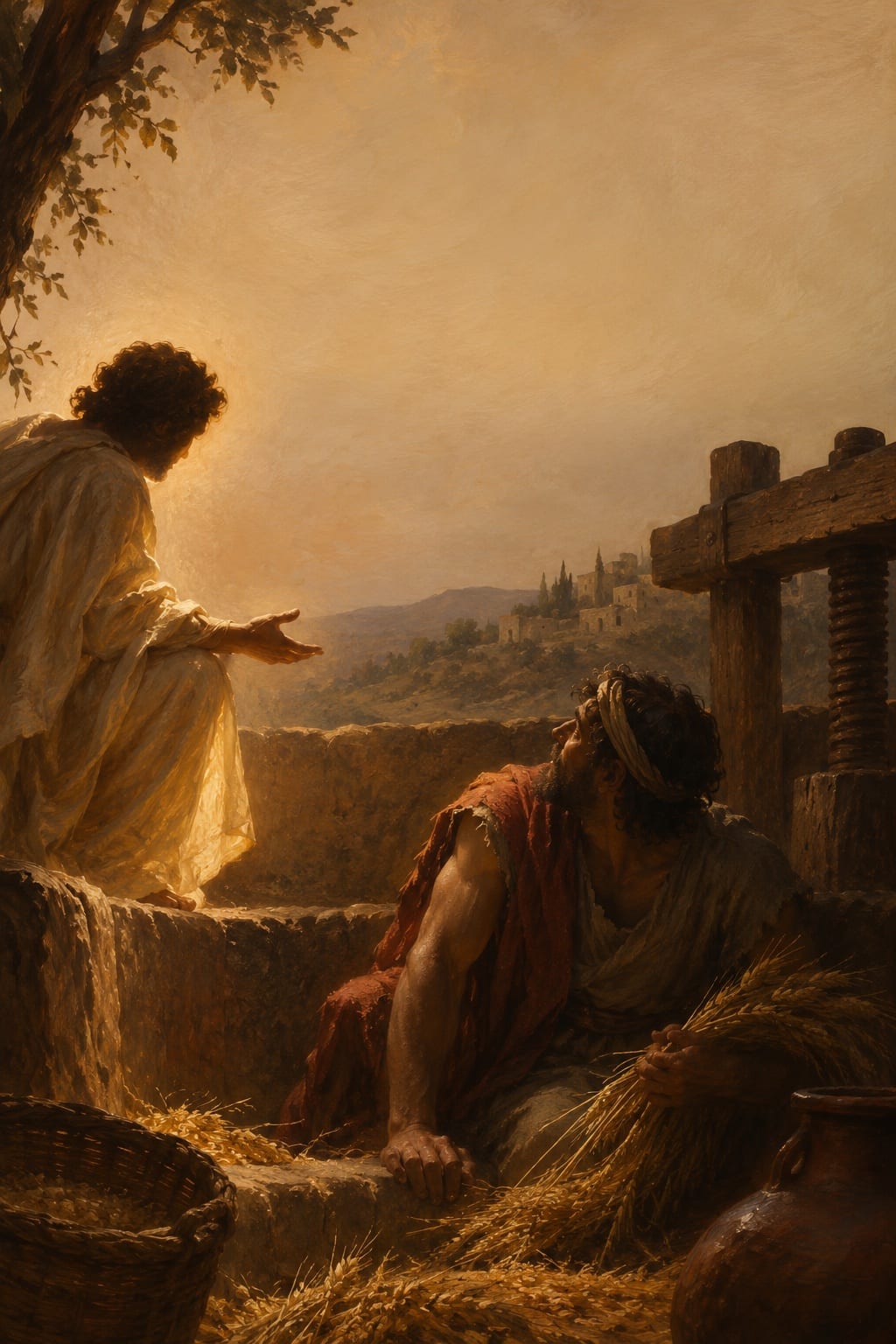
Wheat in the Winepress
Judges 6:11-246 min
When God found Gideon hiding in a winepress, He didn't see a frightened man — He saw a deliverer. This story explores the distance between how we define ourselves and how God has already named us, and what it takes to step out of hiding into assignment.
Scripture
Judges 6:11-24
Key moment Judges 6:12-16
Read
The winepress was underground, carved into rock, designed for crushing grapes — not winnowing grain. Threshing wheat required open air, a hilltop, wind to separate the chaff. But Gideon couldn't afford open air. The Midianites had spent seven years raiding Israel's harvests, stripping the land bare, and anyone caught with food risked losing everything. So Gideon did what survival demanded: he took his wheat underground and worked in secret, tossing small handfuls into the still air of that cramped stone basin, trying to coax the kernels free without the wind he actually needed.
This is where the angel of the Lord found him.
Notice the greeting: "The Lord is with you, mighty warrior." (Judges 6:12). The Hebrew is gibbor hechayil — a term used elsewhere for men of standing, valor, military strength. It's the word for David's elite soldiers, for Boaz's reputation in Bethlehem. And it lands here, in a hole in the ground, on a man hunched over stolen grain.
Gideon's response is honest to the point of being blunt. He doesn't thank the angel. He doesn't fall on his face. He pushes back: "If the Lord is with us, why has all this happened to us? Where are all His wonders that our ancestors told us about?" (Judges 6:13). There's no awe in his voice — just the accumulated weight of a man who has heard the old stories about Red Sea crossings and manna in the desert but can't reconcile them with seven years of watching everything he planted get taken.
God doesn't answer the theological question. This matters. Gideon asks why and God responds with what: "Go in the strength you have and save Israel out of Midian's hand. Am I not sending you?" (Judges 6:14).
The phrase "in the strength you have" is easily glossed over, but it's the hinge of the passage. God doesn't promise to make Gideon into something he isn't yet. He doesn't say, "First, train for battle; then I'll send you." The commission arrives while Gideon is still dusty with chaff, still crouching, still afraid. Whatever strength Gideon possesses right now — the stubbornness to keep threshing when others gave up, the resourcefulness to find a way when the obvious way was too dangerous — that is sufficient. Not because it's impressive, but because the one sending him is.
Gideon tries one more deflection: "My clan is the weakest in Manasseh, and I am the least in my family" (Judges 6:15). This is a man offering God his résumé of inadequacy, hoping it will disqualify him. Smallest tribe. Smallest family within the tribe. Smallest member of that family.
God's reply is seven words that restructure everything: "I will be with you" (Judges 6:16). The calculus Gideon is running — weighing his resources against the Midianite army — operates on assumptions God has no interest in validating. The equation was never Gideon versus Midian. It was God-with-Gideon, and that changed the math entirely.
What follows in the broader story confirms this. God will eventually pare Gideon's army from 32,000 to 300, not because smaller armies are tactically superior, but because the point was never the army. The point was trust — and trust only becomes visible when the safety nets are removed.
But here, in verse 16, none of that has happened yet. Gideon is still in the winepress. Still covered in grain dust. Still afraid. And he's been called a mighty warrior by the God of the universe. The name came before the evidence. The identity preceded the action.
Today
Most of us have a winepress — some version of that underground space where we do the necessary work of our lives in hiding because exposure feels too costly. Maybe it's a creative gift you've only ever exercised in private because you're afraid of what people would say if they saw it. Maybe it's a conviction growing in you about a direction you need to take, but you keep turning it over in secret because saying it out loud would make it real, and real things can fail publicly.
The winepress isn't always about physical fear. Sometimes it's the fear of being seen as presumptuous. Who am I to step into that? Sometimes it's the fear of inadequacy dressed up as humility. I'm the least qualified person for this. Sometimes it's simply the rational calculation that staying hidden is safer than stepping out, and by every measurable standard, that calculation is correct.
Gideon's story disrupts this because God doesn't wait for Gideon to feel ready. He doesn't send him to warrior school first. He names him in the winepress, while the chaff is still stuck to his clothes, while his hands are still shaking. The calling arrives in the middle of the hiding, which means the hiding was never a disqualification. It was just a location.
Consider what Gideon was actually doing when God found him: he was providing for his family. He was doing faithful, unglamorous, necessary work under terrible conditions. He wasn't seeking a prophetic encounter. He wasn't fasting on a mountaintop. He was solving a grain problem in a grape hole, and God showed up there. This suggests that the ordinary faithfulness you're already practicing — the small, hidden, uncelebrated things — might be exactly the "strength you have" that God intends to commission for something larger.
The fear doesn't evaporate when God calls. Gideon will ask for signs — the famous fleece, twice — because the gap between God's word about him and his own feelings about himself is enormous. Closing that gap isn't instantaneous. It's a process of obedience that looks a lot like doing the next thing while your stomach is in knots.
So the question isn't whether you're afraid. The question is whether you'll let your fear have the final word over what God has spoken. There is wheat in your hands right now — provision, gifting, purpose — that you've been threshing in secret. Some of it was meant to be threshed in secret for a season. But seasons turn, and the God who sees you in the low place has already named what you're becoming. Stepping into that name doesn't require the absence of fear. It requires the presence of the One who said, I will be with you.
Pause
Take a slow breath.
Sit with what you've read.
Ponder
What are you threshing in the winepress — what work, gift, or calling have you kept underground because exposure felt too risky?
When you list the reasons you're unqualified, are those reasons based on God's assessment or your own?
What would it look like to take one step out of hiding this week — not a dramatic leap, but one honest step toward the open air?
Pray
A prayer
Father, God who sees the hidden places and names us before we name ourselves, Your kingdom comes not through the powerful and the polished but through the willing — through cracked vessels and trembling hands. Let Your will be done in my life even when I can't see how. Forgive me for the ways I've made my smallness an excuse and called it humility. Forgive me for running the math without You in the equation. I bring You what I have — the strength I carry today, not the strength I wish I had. Commission it. Use it. I don't ask that the fear would vanish, only that Your presence would be louder. Lead me out of the winepress at the pace You choose. Guard me from the enemy's voice that says I should stay hidden forever, and from my own voice that agrees with it. Yours is the kingdom and the power, and if You are with me, the equation changes. I trust You with the math I cannot do
Amen.
Go in the strength you have.He has already named you.