When the Brook Dried Up and God Didn't Explain Why
1 Kings 17:1-164 min
Through Elijah's journey from a drying brook to a starving widow's home, God reveals that His provision often arrives in forms we would never choose — and that scarcity can be the doorway to a deeper knowledge of His faithfulness.
Scripture
1 Kings 17:1-16
Key moment 1 Kings 17:8-16
Read
Elijah had just delivered the boldest prophecy of his life. No rain would fall except at his word. And God's first instruction? Hide. Go east, drink from a brook, and wait for ravens to bring your meals. The prophet who had stood before a king now sat alone by a shrinking stream, fed by birds that Levitical law called unclean. God's provision was real, but it was also strange — daily bread delivered by creatures no respectable Israelite would touch.
Then the brook dried up. The text is almost brutal in its plainness: "After a while the brook dried up because there had been no rain in the land." No angelic visitation accompanied the loss. No explanation softened it. The same drought Elijah had pronounced now lapped at his own feet. God had not failed — the brook had simply fulfilled its purpose. But Elijah didn't know that yet. He only knew the water was gone.
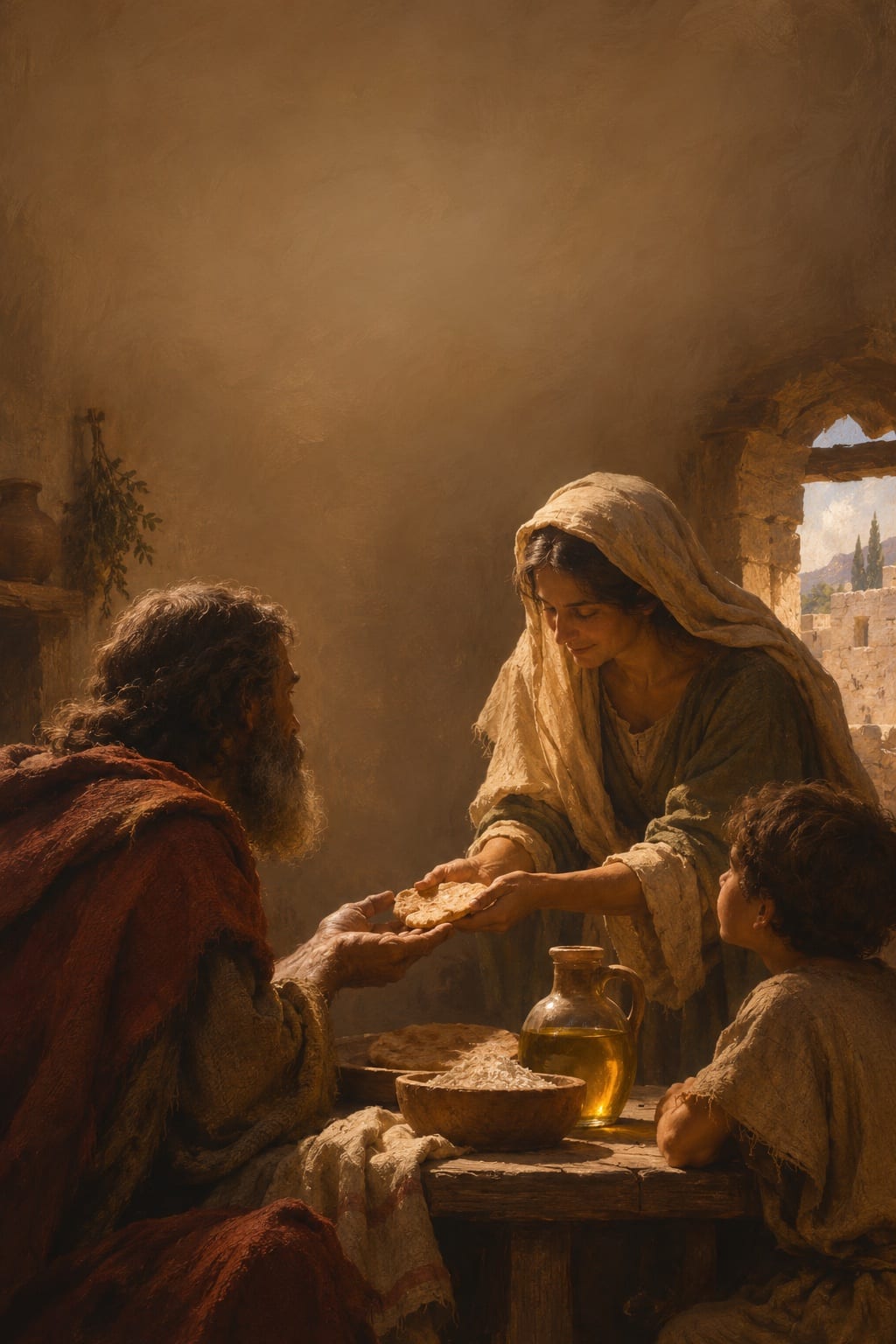
What came next was stranger still. God sent him to Zarephath, a Sidonian town in the heart of Baal territory, to be sustained by a widow who was preparing her last meal. She had a handful of flour and a little oil, and she fully expected to die. God's new provision looked like the opposite of provision: a foreign widow at the end of her resources. Yet Elijah asked her to feed him first — not from cruelty, but because the word of the Lord carried a promise.
"The jar of flour was not used up and the jug of oil did not run dry, in keeping with the word of the LORD spoken by Elijah."
-- 1 Kings 17:16
The flour and oil never multiplied into abundance. They simply never ran out. Each morning the widow reached into the jar and found enough — exactly enough. God's faithfulness didn't look like a full pantry. It looked like a jar that should have been empty but wasn't.
Today
Most of us can name a brook that dried up. A job that ended, a relationship that thinned, a season of health or stability that quietly receded. The loss felt personal even when it wasn't. We prayed, we waited, and the water kept dropping.
What's disorienting about Elijah's story is that God orchestrated both the provision and the drying up. The brook wasn't a mistake God scrambled to correct. It was a station — temporary by design. And the next provision, the widow of Zarephath, would have seemed like a demotion to anyone keeping score. A prophet hiding in enemy territory, dependent on a woman who had nothing. God's math doesn't work like ours.
Scarcity has a way of stripping us down to the actual question: Do I believe God is faithful even when the evidence looks thin? The widow had to use her last handful of flour on a stranger's request before she saw it replenished. That sequencing matters. The obedience preceded the miracle, not the other way around. Trust wasn't the reward for seeing provision; trust was the vessel that received it.
If your familiar stream has gone dry, that silence may not be abandonment. It may be God redirecting you toward a provision you would never have chosen — one that asks more of you, one that looks insufficient, but one that reveals His character in ways comfort never could. The jar doesn't overflow. It just never empties.
Pause
Take a slow breath.
Sit with what you've read.
Ponder
What "brook" in your life has recently dried up, and what have you assumed that drying up means about God's care for you?
Where might God be asking you to step toward provision that looks too small, too strange, or too uncomfortable to trust?
When has enough — just enough, nothing extra — actually been the form God's faithfulness took in your life?
Pray
A prayer
Father, Provider of ravens and flour jars, Your kingdom comes in ways I would not design — through strange messengers and dwindling supplies that somehow hold. Forgive me for mistaking the drying brook for Your absence. Forgive me for wanting abundance when You are teaching me dependence. Give me today what I need today. Not a storehouse, but a jar that doesn't empty. Lead me, even into unfamiliar territory, where Your faithfulness waits in forms I wouldn't have chosen. Deliver me from the fear that scarcity means You have forgotten. You are enough. Make me brave enough to believe it.
Amen.
The jar is not empty yet.He who sustained the widow sustains you — one faithful morning at a time.